

Shenzhen Han’s CNC Technology Co., Ltd. · Shenzhen, Guangdong
Han’s CNC: start with the PCB hole.
Mechanical through-holes, laser blind holes and depth-controlled work need different process briefs—not just a spindle count.
Choose a drilling route ↓PCB equipment RFQ ↗
Official English/Chinese process material and issuer identity reviewed 8 October 2026
The hole’s function selects the first conversation.
Han’s CNC develops equipment for printed-circuit-board manufacturing. Its drilling directory distinguishes mechanical through-hole machining from laser drilling; its process overview also discusses back-drilled holes and CCD independent-control drilling. A general metalworking machining-centre specification is not the right starting point for this supplier.
| Panel requirement | Official route to discuss | What the buyer should supply |
|---|---|---|
| Mechanical through-holes | F6MHAU and F12MHAU mechanical-drilling series | Laminate, finished stack thickness, drill diameters, hole count and registration requirement |
| Laser-drilled blind holes | CO₂ and UV+CO₂ routes in the broader process offering | Dielectric and copper structure, intended stop layer, opening geometry and acceptable residue |
| Back drilling or demanding registration | Depth-control and CCD process discussion; select the exact offered machine | Target depth/residual stub, layer locations, fiducials and the inspection method |
Swipe on a phone. This is a process map, not confirmation that F6MHAU performs every operation above. HD is a separately listed double-platform, two-beam CO₂ laser-drilling family.
Separate drill size from the final hole requirement after later processing. Define whether the enquiry concerns through-vias, blind features or removal of an unwanted stub. A family name alone does not establish the smallest usable drill, maximum stack, depth-control capability or positional result on your laminate.
F6MHAU: qualify the automatic panel flow.
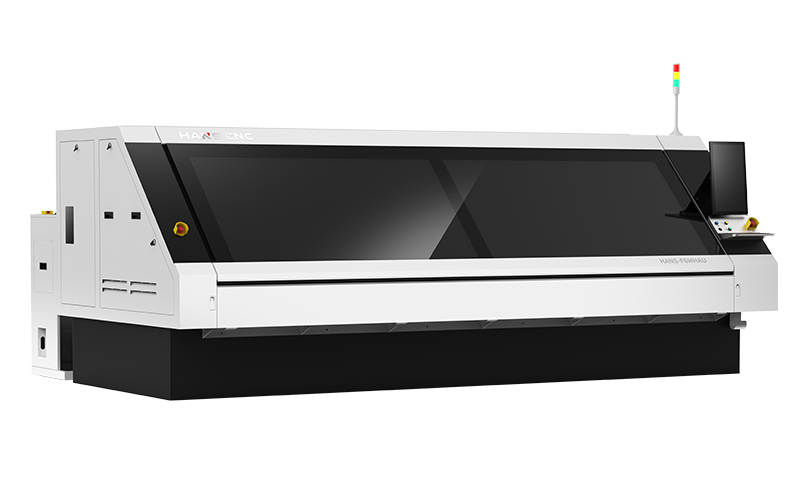
The official directory associates HANS-F6MHAU with mechanical through-hole machining. Its English detail highlights automatic material loading/unloading. The corresponding Chinese page describes automatic code scanning to select job information, panel expansion/shrinkage compensation, abnormal-condition alarms and capacity/energy management through a central-control system.
Use those published functions to scope a demonstration: identify a panel, load its correct job, verify orientation and registration, handle an abnormal condition, unload and reconcile accepted output. Ask which hardware, software and interfaces are included in the exact quoted build; the feature list is not a guarantee that every configuration contains the complete workflow.
Inspect the retained F6MHAU model page ↗The manufacturer advertises a utilisation figure on this page. Treat that as its claim under unspecified conditions, not a promised production result. Agree what counts as productive time and whether loading, drill changes, setup, alarms, inspection and rejected panels are included. Compare accepted panels from the same representative job, rather than turning a headline percentage into a delivery commitment.
Describe the stack before asking for speed.
- Material and stack
- Give the actual laminate construction, copper distribution, panel dimensions, individual-board and total stack thickness, entry/backup materials and planned stack quantity. Ask the supplier to qualify that combination rather than borrowing a capacity from another series.
- Registration
- Identify fiducials, panel orientation, expected dimensional variation and critical hole-to-feature relationships. For the published expansion/shrinkage compensation, ask how reference data are acquired and how the transformed job is checked on a representative panel.
- Tools and extraction
- Provide drill sizes, hole counts, smallest critical features and a tool-change/wear policy. Settle the supplied spindle/tool package and extraction/utility requirements; neither can be inferred from the F6 name or a photograph.
For a back-drilling project, submit target depth, stack variation, layer location and residual-stub acceptance separately. Ask the offered machine’s depth-control method and how the result will be inspected. Do not add that capability to F6MHAU simply because the wider company discusses back drilling.
A trial should follow panels from job selection to usable holes.
Freeze a representative job
Agree laminate, stack, drill program, entry/backup materials, tooling and the required incoming condition. Include the difficult hole sizes and feature positions from the real order. Record the exact machine and supplied software configuration.
Run the complete panel sequence
Check job identification and panel orientation, loading/registration, drilling, tool changes, abnormal-condition recovery and unloading. Record accepted panels, rejects and operator intervention alongside elapsed time. A cutting-only demonstration does not test the automatic panel flow.
Inspect the agreed outcomes
Agree hole position and size, entry/exit condition and any required internal-wall or depth assessment using an appropriate inspection method. Keep material, tooling and inspection traceability with the samples. Finished-board electrical or plated-hole acceptance is a separate downstream requirement, not proof supplied by the drill enclosure.
PCB equipment is the confirmed company scope.
The official company introduction names Shenzhen Han’s CNC Technology Co., Ltd., founded in 2002, as a developer, producer and seller of specialised PCB equipment. The 30 March 2026 issuer announcement identifies 深圳市大族数控科技股份有限公司 and A-share code 301200. It corroborates the named reporting entity; it does not certify a machine or substitute for factory or sample acceptance.
The official material addresses PCB manufacturing for AI computing, automotive electronics, communications and other electronic products. These are application markets, not evidence that a particular machine is approved by any named customer. Do not confuse this PCB business with similarly branded general machine-tool businesses.
The company service page describes process-research, technical-support, service and logistics teams. Its company page lists locations in China, Thailand, Singapore and Vietnam. For your destination, ask which legal entity and team will install the machine, support its software and supply spares; a listed location is not proof of local stock or a contractual response time.
Before ordering, settle utilities and extraction, site access, panel handling, job-data interfaces, training, spare/tool supply and ownership of the accepted process documentation. If the request is for metal-cutting work, or a hole process beyond the offered configuration, obtain the correct supplier and model rather than stretching this PCB profile to fit it.
Send a PCB process brief, not “best drilling machine”.
Panel: laminate/copper structure, dimensions, board and stack thickness, entry/backup materials.
Holes: through/blind/back-drilled type, sizes/counts, critical registration or depth, inspection and downstream requirements.
Production: batch mix, loading/identification workflow, tool policy, utilities, data interfaces and destination.
Acceptance: representative job, complete cycle boundaries, accepted-panel output, inspection records and recovery demonstration.