

山东临磨数控机床装备有限公司
Linqing, Shandong
Linmo rotary-table grinding: choose the wheel contact and the holding method
For plates, rings and two-face parts, compare horizontal-spindle peripheral grinding with vertical-spindle face grinding. Judge flatness on the released part, after the magnetic hold is removed.
Company introduction and both existing model pages reviewed 8 October 2026
Start with the surface that the wheel must finish
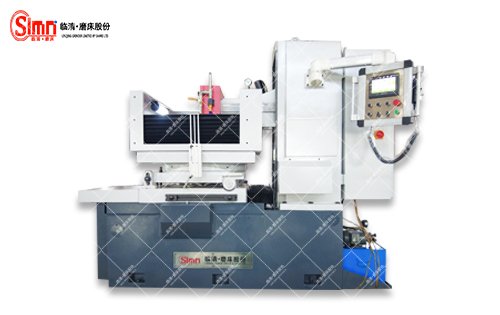
MP7363A · horizontal spindle
Peripheral contact for the two-face route
The exact model description lists a 630 mm worktable. Its table rotates on the bed guideway; the carriage traverses along a twin-column crossbeam and the grinding head feeds vertically. Grinding uses the wheel periphery.
For a disc, blade blank, ring or plate with two controlled faces, specify how the first face becomes the reference for the second. The manufacturer's description of two-face parallelism does not mean both faces are ground simultaneously or without turning the part over.
MP7440 · vertical spindle
Wheel-face contact with a magnetic table
The exact model page lists a 400 mm worktable and wheel-face grinding. It describes a circular electromagnetic chuck with smoothly adjustable holding force, electrical magnetizing/demagnetizing and coolant purification.
First check whether the material and its contact area can be held magnetically. A nonmagnetic part, a small interrupted contact footprint or a tall part needs a separately agreed fixture and process. The catalogue's broad material/industry list is not proof that one standard magnetic setup suits all of them.
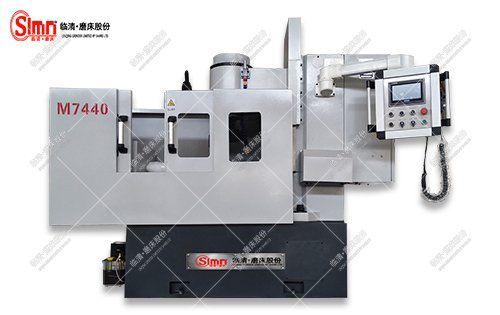
Table diameter is only the first fit check
Use the part plus stops, supports, fixture and wheel-access path. Confirm swept diameter, height clearance, load and contact area on the actual supplied chuck. The MP7363A page's broader image table groups MK/P7363 variants without an A column; MP7440's image table groups MK/P7440 and lists a different diameter from its individual-page text. Those family figures are not combined into a made-up exact-model configuration.
A flat surface on the magnet can spring back after release
For a thin disc or plate, separate holding security from elastic deformation. Describe the incoming bow, thickness, hardness and the support/contact pattern. Ask the supplier to establish enough holding force for the proposed cut while avoiding a setup that pulls the blank into a temporary shape.
- Ferromagnetic, broad contact
- Trial the actual chuck pole arrangement, stops and magnetizing setting with the intended stock allowance. Check that the part remains secure through grinding and wheel withdrawal; a magnetic-force figure does not replace this loaded-part test.
- Thin, bowed or interrupted contact
- Specify support locations and a staged removal plan. Keep incoming and released flatness measurements. If the first face is used to locate the second, clean the support/chuck face and show how it contacts the finished reference without trapping abrasive debris.
- Nonmagnetic or mechanically held
- Request a fixture drawing with clamp forces, wheel access and sweep clearance. Prove released shape and surface relationships with that fixture. Do not assume the standard electromagnetic arrangement can hold glass, ceramic or every stainless alloy.
Agree demagnetizing, safe release, cleaning and residual-magnetism acceptance for the downstream process. For a part that will be assembled or inspected elsewhere, the relevant result is its free condition after removal from the chuck.
Quote a grinding recipe, not just a spindle arrangement
Provide material, hardness, surface treatment, interruptions and removal allowance. Agree abrasive, bond, grit, grade, wheel geometry and permitted operating speed. Peripheral and face contact use different wheel/contact geometry; specify the installed wheel rather than transferring a family-table wheel entry to the A model.
Choose the dresser and dressing interval for the actual part mix. Include wheel wear/compensation, spark-out and re-dressing in the trial. A process that meets finish immediately after dressing may drift before the planned batch ends.
MP7440's description includes purification, but not a guaranteed filtration grade or delivered flow/temperature. Define the coolant, filtration, nozzle placement and waste handling. Compare clean-wheel cutting and heat control on the actual material; coolant equipment is part of the purchase scope.
The pages' broader material illustrates PLC/HMI automatic and manual operation. Confirm the supplied model's sequence, feed setting, dressing compensation and restart behavior. An automatic rough/finish/spark-out cycle does not establish a contour-CNC or multi-axis interpolation package.
Accept the part after grinding, demagnetizing and cooling
Measure the incoming blank
Record flatness/bow, face allowance, thickness and material/hardness. Identify the drawing's measuring datums, supports and surface-finish requirement. Use the difficult blank condition rather than an unusually flat demonstration piece.
Run the complete two-face or one-face route
Retain the wheel, dressing state, fixture/chuck setting, infeed, coolant and spark-out. Where both faces matter, include the actual turnover and second-face locating method. Time loading, dressing, cooling and release as well as grinding.
Inspect in the free condition
After demagnetizing, cleaning and the agreed temperature stabilization, measure flatness, parallelism, thickness distribution and finish with the specified method. Check grinding damage or residual magnetism where the drawing/process requires it. The magnetically held surface alone is not the acceptance result.
Repeat through a dressing interval
Use the intended batch and part mix, include wheel wear and a stop/restart, and retain accepted/rejected counts. Agree the inspection frequency and any destructive or surface-integrity checks needed for the material.
The MP7440 text gives an imprecise roughness expression and a parallelism claim without the test-piece conditions or measurement procedure. Use a written drawing-specific acceptance plan; neither entry is a universal warranty for your released part.
Keep the new-machine, customized-process and repair scopes separate
Shandong Linmo's introduction identifies its Linqing business as rotary-table surface grinders, other surface-grinding arrangements, customized special grinders and machine repair. Its catalogue separates horizontal/vertical rotary-table grinding, rectangular-table grinding and shear-blade forming equipment. These two references cover distinct rotary-table routes; they do not substantiate the specifications of the broader semiconductor or compound-grinding families.
The introduction describes a team drawn from the former Linqing grinder operation. That heritage is different from the present contracting entity's incorporation date. The reviewed introduction also describes regional service offices; establish support for the destination and supplied machine in the contract.
Resolve the service terms before placing the order
The page header advertises an 18-month warranty while the company introduction says one year. Ask for one signed scope specifying the start date, parts/labor, remote versus onsite work, travel, exclusions and response route. For a repaired or customized machine, define which assemblies are new, reused or modified and which inspection records cover the completed configuration.
Request the machine/chuck electrical drawings, foundation and lifting information, wheel/dressing instructions, lubrication schedule, control backups and measured factory-acceptance record. Match those documents to the delivered serial number and installed process package.
Send the part in its free condition, not just its nominal diameter
Include a drawing; material, hardness and magnetic suitability; incoming bow/allowance and final thickness; faces/datum relationships and inspection limits; supports and holding contact area; proposed wheel/coolant; batch and dressing interval; destination, service needs and MP7363A or MP7440 configuration requested.
Send Linmo RFQ ↗