

Wuhan Heavy Duty Machine Tool Group · Wuhan, Hubei
Plan the large part and its installation together.
A heavy vertical lathe needs more than a turning diameter. Workholding, tool reach, lifting, foundation and acceptance belong in the same project.
Official CK52 / CKX52 material and dated Wuhan government project reporting reviewed 8 October 2026
Keep CK52 turning and CKX52 milling scope separate.
Wuhan Heavy Duty Machine Tool Group’s official range includes vertical and horizontal turning, boring/milling, gear machining and specialised heavy equipment. The retained CK52 series record is a double-column vertical-turning reference. Its official 2018 product material distinguishes CK52 turning from CKX52 turning/milling. A series name alone does not identify one table, load rating or included milling head.
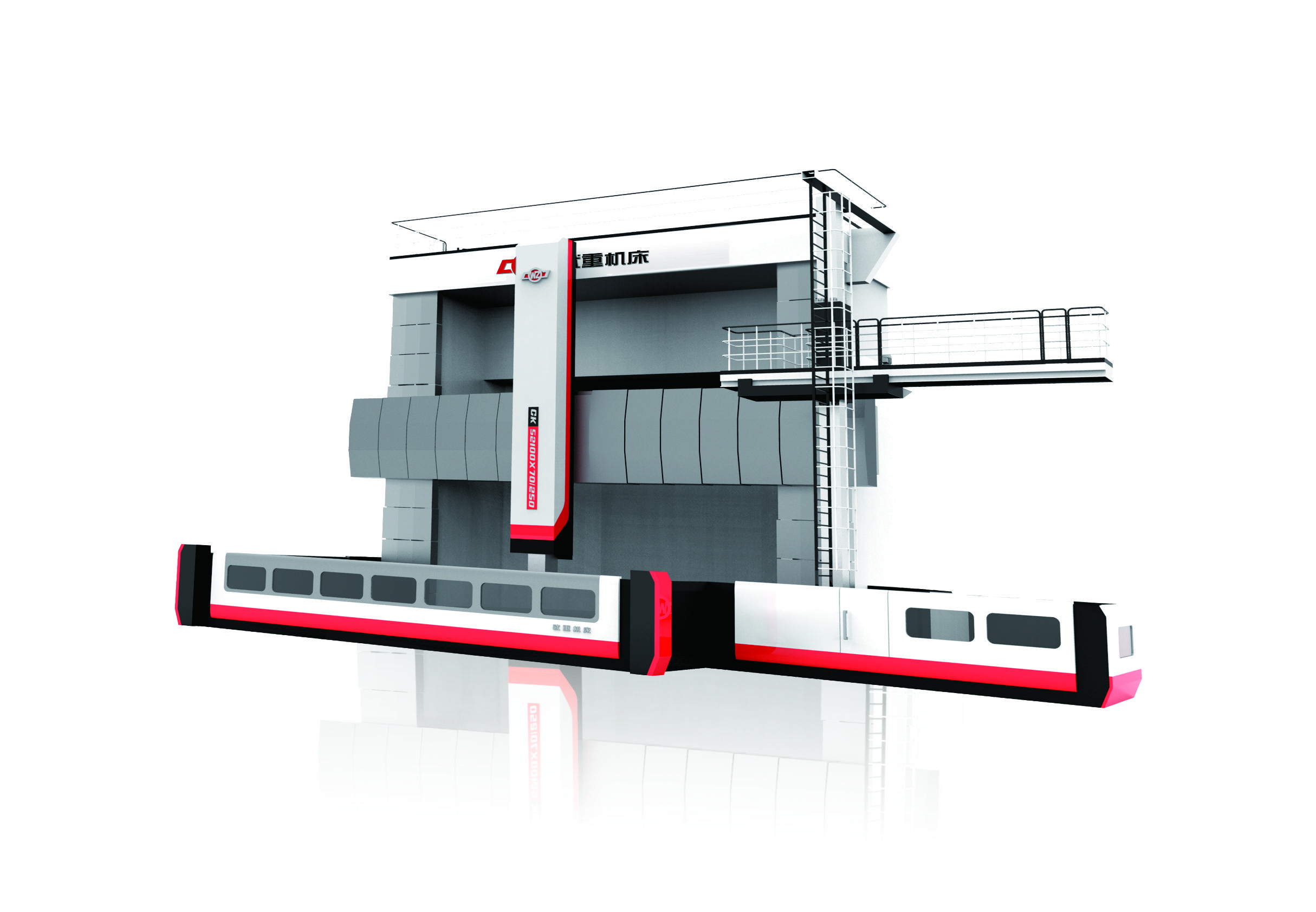
For an annular or disc-like part, first list the turning faces, bores, grooves and datums. If the job also needs drilling, indexing or milling, identify those features separately and ask for the required head, rotary-table function, tool interface and controller functions. A vertical-turning machine does not gain those capabilities simply because the related series offers them.
The drawing that starts the discussion
Send the part in its loaded orientation with fixture/chuck details, clamping allowance, datum sequence and every required cutting location. Add the finished geometry, material, rough stock and removal allowance. The supplier can then propose one coherent turning or turn/mill build.
Use four limits instead of one maximum diameter.
- Rotating envelope
- Include the actual jaws, clamps, part overhang and sweep, not just the finished outside diameter. Check obstructions at each required machining and loading position.
- Loaded height and reach
- Include fixture thickness and the highest feature. Check crossrail position, ram and holder approach, with usable reach at the required cutting coordinates.
- Mass and support
- Provide total loaded mass, its distribution and centre of gravity. Obtain the exact table-load condition and workholding/support plan; a diameter does not establish permissible mass.
- Cutting and rotation
- Define material, imbalance, interrupted cut, tool projection and speed range. Request torque/power duty and the rotation/indexing arrangement for the offered build.
These limits interact. A very heavy fixture may change support, speed and handling; a long ram/tool projection may change the suitable cut. Use an agreed configuration drawing and a representative process trial instead of combining separate catalogue maxima into a hypothetical workpiece.
Do not combine the old catalogue with a newer project machine.
The official 2018 CK52/CKX52 material contains separate numerical rows for multiple sizes and configurations. A manufacturer catalogue preserved by an exhibition organiser uses CK(X)52 notation and discusses a different option/controller presentation. Its explanatory range starts at 3.5 m while its table also contains a 2.5 m column. Keep the actual row, document revision and technical agreement together; the retained series URL is not a single-model specification.
A June 2026 Wuhan economic-and-information bureau report describes a specific CKX52160 project with 16 m maximum turning diameter, 500 t table capacity and 27.5 m overall height. These are attributed figures for that reported machine. They are not assigned to the older CK52 record, and a reported project acceptance is not a general guarantee for another job.
The catalogue discusses single/double heads and optional milling heads, magazines, tool setting, workpiece measurement and a grinding head. Confirm which items belong to the exact build and the compatibility of heads, tool interfaces, controller functions and the intended process. A feature appearing in a family brochure is not automatically included equipment.
Design the arrival, lift and foundation before ordering.
Handling and access
Ask for shipping splits, assembly sequence, lifting points and weights of the machine sections and loaded workpiece. Review transport access, crane reach/capacity, loading path and turning/maintenance clearances using the actual site.
Foundation and utilities
Obtain the manufacturer’s foundation/anchoring and service drawings for this build. Allocate responsibility for civil design, load assessment, supply power, cooling, hydraulic systems and chip/coolant handling. Do not estimate a foundation from the catalogue’s machine weight.
Assembly and commissioning
Agree factory checks, site assembly/alignment, controller and drive commissioning, guarding, operator access, documentation and training. Identify the named party that accepts each interface and corrects commissioning defects.
Maintenance and recovery
Plan access to service points, lubrication/hydraulic monitoring, chip removal and safe loading. Include restart after an interrupted operation and the handling of the actual large part, with procedures reviewed by the responsible site team.
Accept the process, not only an unloaded machine movement.
Use the representative material and loaded fixture. Agree the difficult interrupted cut, furthest feature and longest tool/ram position, then record cutting parameters, support, coolant and thermal conditions. For milling, include indexing, head/tool changes and the critical relationship between turned and milled datums.
Define released-part dimensional and geometric checks, finish, measurement locations, temperature and sampling. Separate machine-axis verification from part acceptance. Record the complete cycle, including lifting/loading, alignment, tool changes, clearing, inspection and unloading, with interventions visible.
The current official site identifies 武汉重型机床集团有限公司 and describes its heavy/super-heavy equipment business within China North Industries Group. Government reporting confirms specific projects, not the specification or suitability of a future order. Confirm current legal seller, builder, serial-machine documentation and destination service scope before contracting.
Prepare a heavy-part project brief.
Include part/material, finished and rough dimensions, fixture and loaded mass, centre of gravity, turning and milling features, datum/inspection requirements and representative lot size. Add the proposed site layout, handling access and utilities.
Request an exact CK52 or CKX52 configuration and revision, with workholding/reach drawing, standard/option schedule, foundation and commissioning responsibilities, and a released-part trial.
Prepare a Wuhan RFQ ↗