

DESUN SEIKI · Turning and mill-turn equipment · Jiangsu
Specify the spindle package, not just the model size.
Bar capacity, chuck, tailstock, second spindle and Y motion need to belong to the same quoted build. Keep the retained A references distinct from the current TLX catalogue.
Current group TLX material, original specification sheet and dated exhibition identity reviewed 8 October 2026
Keep the A reference and supplied revision together.
The directory retains A-300, A-500 and A-800 at their original URLs. The older model source could not be loaded in this review. The currently readable group catalogue names TLX-300, TLX-500/600, TLX-800 and TLX-1250; matching a number in the name does not prove that a TLX configuration is identical to an old A record.
It should state the ordered model and revision, whether an old A designation maps to the proposed current machine, and the complete spindle, turret, axis and support options. Numerical TLX rows are not copied into the A specifications here.
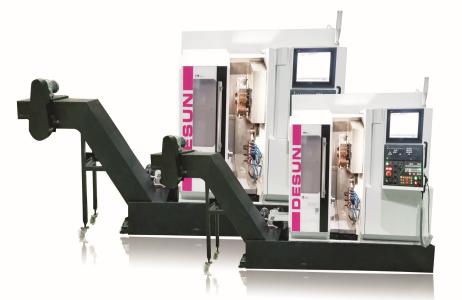
The group material describes turning/mill-turn equipment and a configurable production route. Its product heading, detailed prose and downloadable sheet do not consistently describe the same turret or option arrangement. The signed supplied schedule should resolve those differences instead of assuming the most capable combination.
Choose a coherent spindle and workholding package.
The TLX material lists alternative spindle sizes, through-bar dimensions and chuck options. Those entries are alternatives, not simultaneous capacity for every machine. Confirm the supplied spindle nose, actual usable bore and permitted bar capacity, collet or chuck, jaw set and allowable workpiece projection as a package.
- Through-bar work
- Give bar diameter, material, straightness, feeder interface and remnant length. Establish spindle/collet limitations and safe support through the operating speed range. A bore measurement alone is not the accepted bar capacity.
- Chuck-held blanks
- Give blank size/mass, jaw engagement, locating stop, grip surface and cutting load. Confirm the actual chuck/jaws and tool sweep; chuck diameter alone does not prove holding quality or safe cutting duty.
- Second-end work
- Specify the receiving grip, axial datum and second-end features. Confirm the actual sub-spindle option, clamp verification and transfer sequence rather than assuming a second spindle from the series illustration.
Keep power and torque with the selected spindle and its duty definition. The group brochure's alternative values do not establish a universal continuous cutting capability. Obtain the exact motor/drive schedule and a material-specific trial.
Use part length to review support and access.
A-300 reference: show the compact setup
For a short part or bar-fed sequence, include jaw projection, tool-holder length, cutoff and receiving access. Request the actual machining envelope; the designation is not proof of usable cut length once tooling and workholding are installed.
A-500 reference: define the second operation
Show the first-end datum and any second-end grip. Decide whether support, reclamping or spindle transfer is required. Check turret access with both the intended holder and the support/receiving arrangement.
A-800 reference: review the loaded long-part route
For a longer workpiece, show unsupported projection, centre/support needs, deep features and chip evacuation. Ask for the exact loaded setup and support motion; a longer nominal axis range does not resolve bending, vibration or access.
Where off-centre milling is required, specify feature positions and tool orientation, then confirm Y motion and controller functions on the actual build. A sub-spindle changes second-end handling; a Y axis changes a tool path. Neither substitutes for the other.
Make the turret, coolant and control usable for the job.
The current TLX page discusses a BMT live-tool turret and Mitsubishi M80 control, while the downloadable table includes station/configuration alternatives. Request the actual turret/station schedule, holder interfaces, driven-tool speed/torque, clearances and software functions. Do not treat the largest listed station count or an option as standard on an A record.
For deep drilling or boring, define tool assembly, material, depth and chip-removal requirements. The page and sheet contain different coolant package references and a malformed pump-power entry. Request the supplied pressure/flow at the required condition, filtration and pump duty, without silently fixing the original units.
Agree programming/post-processing, tool setting, spindle synchronisation and recovery functions where used. A controller's general supported capability does not establish which functions, options and machine integration are delivered.
Inspect the part after the whole route.
Use the actual loaded setup
Supply material and blanks, jaws/collets, support, receiving grip and longest assembled tools. Include the difficult bore, off-centre feature and second-end operation where they matter.
Run the supplied configuration
Record model/revision, spindle and turret packages, controller/software, coolant, cutting conditions and any transfer/feeder sequence. Include clamp verification and recovery from an interrupted operation.
Measure released parts
Check dimensions, surface condition and datum relationships after unclamping, including transferred second-end geometry. Agree measurement conditions, sample quantity and thermal/handling boundaries. Maximum spindle speed or brochure positioning is not a finished-part guarantee.
Time normal production
Include loading, locating, cutting, transfer where used, unloading, checking and routine interventions. Record rejected parts and rework separately from the best cutting-only cycle.
Match DESUN to the legal builder on the order.
The original 2023 DMP exhibition catalogue names 江苏德上精密机床有限公司 — Jiangsu Desun Precision Machine Tool Co., Ltd. — and the same company website used by this directory record. It lists turning-related D52, TJX, THX and TZX exhibits. This is dated exhibition identity evidence, not a current registration certificate or approval of an A build.
The currently readable IPE group site publishes DESUN/TLX material and links that company website. Group context and product descriptions do not by themselves confirm the present contracting entity, ownership details or the factory that supplies a particular A configuration.
Ask the quotation to name the legal seller, actual builder and production/commissioning location. Assign control/drive support, spares, operator training and destination installation/service responsibility. Keep related group products separate from the supplied machine and acceptance commitments.
Send the complete turning route.
Include material/blank or bar, drawings and datums, grip/support, second-end and off-centre features, longest tools, tolerances, batch mix and loading method.
Name the retained A reference and ask for an exact current build mapping, model-marked photographs, spindle/turret/axis schedule and a released-part acceptance trial. Add installation and destination support requirements.
Prepare a DESUN RFQ ↗