

江苏金方圆数控机床有限公司
Yangzhou, Jiangsu
JFY: choose the sheet process from the finished part
Repeated holes and formed features lead to a turret-tooling review. Changing contours lead to a laser cutting trial. Compare the complete job through bending and assembly.
Domestic and international catalogues, original images and company records reviewed 8 October 2026
Start with the features, not a speed headline
| Your job | First route to evaluate | What determines the choice |
|---|---|---|
| Repeated holes, slots or a perforation pattern | Turret punching | Required tools, pitch, hole quality, clamp zones and the actual sequence |
| Louvers, embossing or other formed features | Suitable punching/forming tools | Tool availability, forming height, tool/clamp clearance and sheet distortion |
| Frequently changing flat contours | Fiber laser | Material/thickness, kerf, small features, gas and accepted edge condition |
| Blank cutting followed by bends or assembly | Compare the full route | Datum consistency, burr orientation, flatness and downstream fit—not cutting alone |
Swipe for the complete process comparison.
A laser cuts a contour; it does not replace a forming tool's raised feature. A turret's quoted hit rate does not include every tool change, sheet move and unload. For a mixed part, submit the entire drawing and ask whether one process, two operations or a different tool plan produces the required finished result.
Build the tooling and clamp plan together
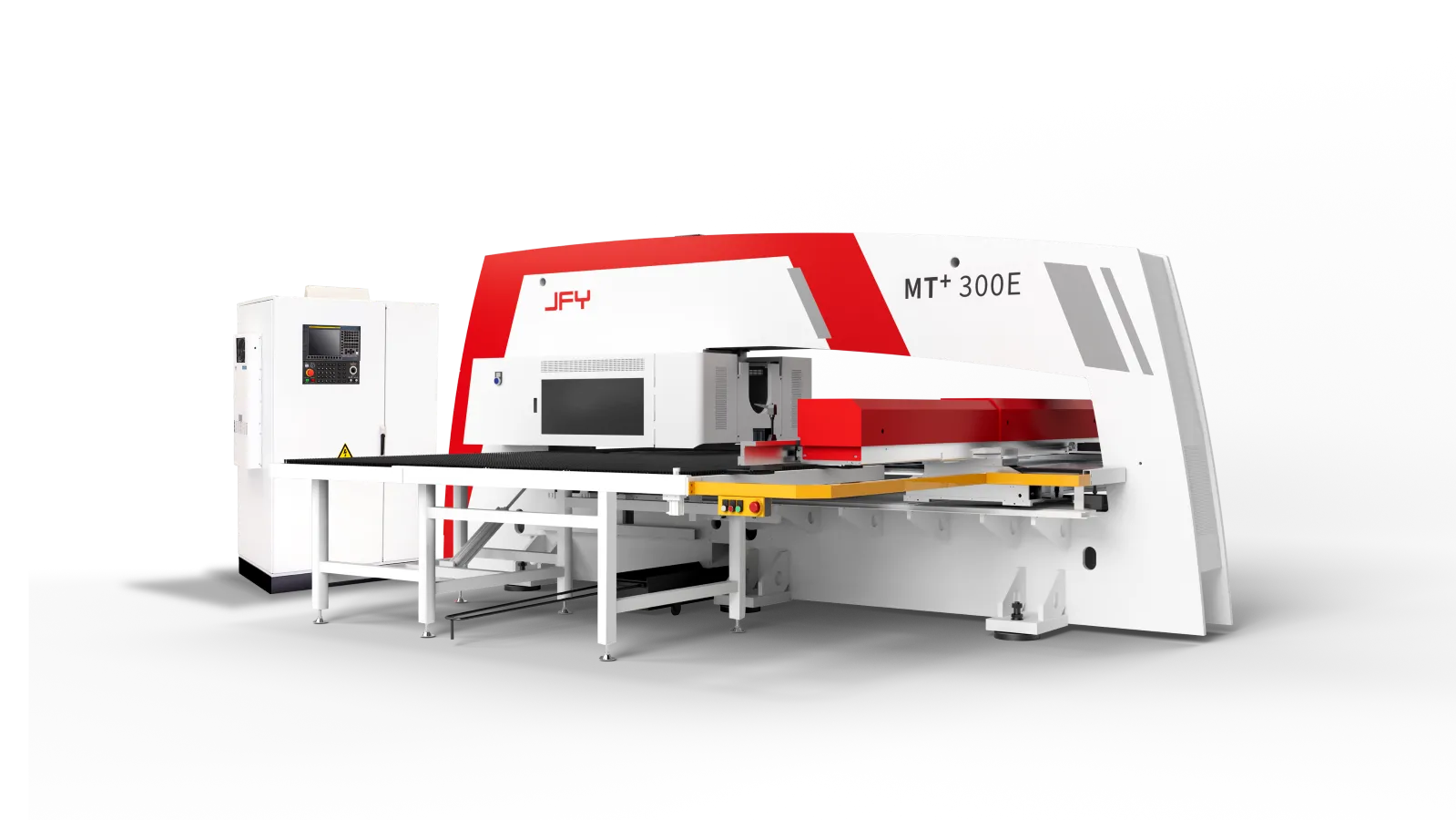
Three existing format records
Select the format only after checking blank width, the tool layout, clamps and the drawing's reachable features. Obtain the exact MT+300E model specification with the quote.
JFY lists MT and MT+ separately. Its current international MT300E table is a reference for the plain MT family; those numbers are not assigned here to the three MT+ records.
Repositioning increases reach; it does not remove the clamp problem
The international MT300E reference lists three clamps and 5000 mm sheet processing length with one repositioning. Ask for the initial working zone, clamp dead zones, protected tool paths and how the sheet is held during the move. Show critical features crossing the repositioning boundary and agree how their relationship will be measured on the finished sheet.
- Tools and formed features
- The plain MT reference lists 32 stations and two auto-index stations. Your ordered turret needs its own station/tool allocation: cutting and forming tools, sizes, orientation, tool-height limits and spares. Do not treat station count as the number of every tool type available simultaneously.
- Sheet support and surface
- Its table distinguishes brush support for thin sheet, brush/ball support for intermediate thickness and ball support for thicker sheet. Specify coating, scratch limits, sheet mass and support choice for the actual order. The published mild-steel thickness limit is not a universal stainless or aluminum punching capacity.
- Pitch and complete cycle
- The MT reference separates 780 hits/min at 1 mm pitch from 400 hits/min at 25.4 mm pitch. Neither is a demonstrated cycle for your nest or an MT+ performance guarantee. Include tool indexing, nibbling, forming, repositioning, loading and unloading in the timed trial.
BFC 3015: one bed, several laser packages
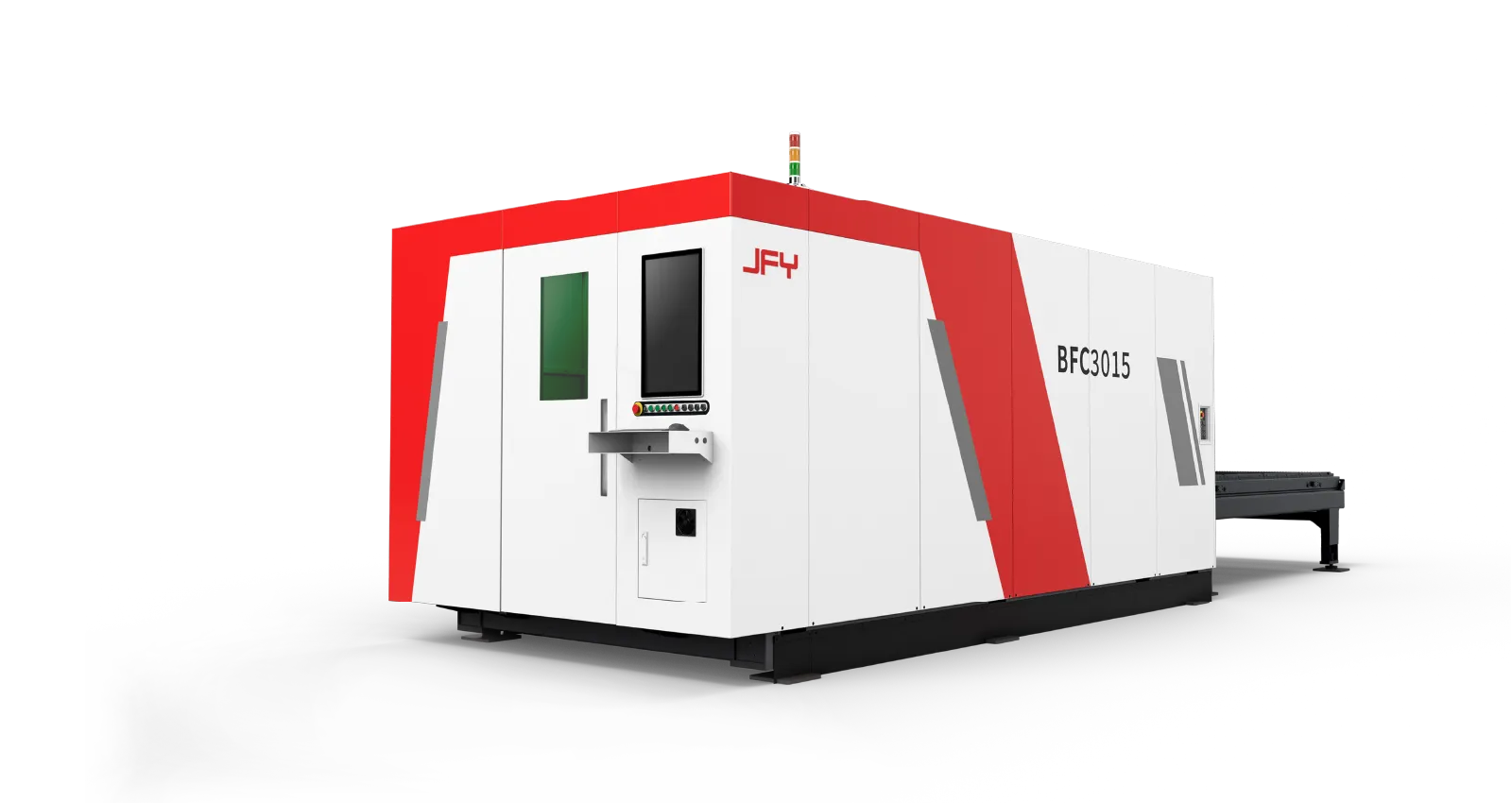
These entries come from the international BFC table opened during this review. Axis strokes and sheet processing size are different quantities. They also differ from earlier catalogue data: request the dated specification for the quoted generation and package instead of combining figures from different versions. BFC+ is a separate series.
The current international description names JFYMAX Elite laser technology, INOVANCE drives, BOCHU FSCUT Bus Control and JFY CUT programming, with JFY PLUS as an optional software upgrade. Confirm the actual source, head, controller version, licenses and functions included in your order. The domestic page's more general description does not establish an identical regional configuration.
The table's combined X/Y speed of 140 m/min and acceleration of 1.7 G concern motion. They are not cutting rates for a particular material. Agree grade, thickness, assist gas, nozzle, focus, piercing and cut-edge requirements, then test them on a representative nest. Axis positioning figures do not substitute for acceptance of finished holes and contours.
Accept a usable part through the next operation
Deliver a complete drawing package
Identify drawing revision, material grade, thickness, coating, blank size and the datums used by bending or assembly. Include the smallest features, tightest pitch and any formed details. Separate cut dimensions from dimensions required after bending.
Run a representative sheet
For punching, include features near clamps and across any repositioning boundary. For laser, include edge-of-sheet and central features, long cuts, small holes and narrow webs. Record tools or laser settings, nesting strategy and material identification with the sample.
Measure and finish the part
Check hole/contour relationships, burr or dross, formed-feature height and sheet flatness against the drawing. Bend or assemble the trial part where that is part of the job. Confirm which side faces the tooling and whether deburring or straightening is needed before the next operation.
Time and document the whole handover
Record loading, programming, processing, tool/consumable changes, sorting, unloading and required finishing. Obtain the NC program, process sheet, measurement method and operator training scope. Agree the batch acceptance sample and what happens when a part falls outside tolerance.
Plan utilities and service as part of the purchase. A punch needs the quoted electrical and air supply; a laser also needs the appropriate gas, cooling and extraction arrangements. Request the actual layout, safety/interlock documentation and destination conformity documents for the machine supplied. Clarify local commissioning, training, parts support and the contracting service entity.
The Yangzhou manufacturer and the supply package
The domestic site identifies 江苏金方圆数控机床有限公司 in Yangzhou, Jiangsu. Its catalogue covers bending, turret punching, laser cutting, shearing, busbar equipment and sheet-metal automation. The international JFY portfolio also describes software and service. This page focuses on the punch and laser records already linked below; it does not imply the whole catalogue has been individually reviewed.
The Ministry of Commerce's original second-quarter 2013 concentration list records approval of TRUMPF Singapore's acquisition of part of the company's equity on 3 April 2013. The group's 2024/25 annual report separately lists the Yangzhou company at 100% indirect ownership as of 30 June 2025. Those dated corporate records support the relationship; they do not make a JFY machine identical to another group brand's model or certify the equipment ordered.
Catalogue facts above are attributed to reviewed manufacturer material; process comparisons and trial steps are CNCVerified purchase-planning analysis. Match the purchase contract, machine specification, invoice entity, delivery configuration and service responsibility before placing an order.
Send the part and its next operation
Attach a drawing or nest, material/thickness, coating, blank size, holes and formed features, dimensional/edge requirements, bend or assembly needs, batch target and destination. State existing tooling, clamp or loading constraints and the proposed punch or laser reference.
Send JFY RFQ ↗