

WORLD Precision · Metal forming and laser equipment · Danyang
Is the cut made before or after forming?
Flat sheet and a formed three-dimensional part need different locating, tool-access and acceptance plans. Choose the process stage before comparing an LD laser build.
Current issuer material and FY2025 report reviewed 8 October 2026; retained LD references require a current build confirmation
Start from the manufacturing sequence.
WORLD's current issuer material describes standard and customised stamping machines and related components, with CNC laser cutting in the wider range. Its forming scope makes the order of operations a useful first question: do you cut the flat blank, or trim holes and edges after the part has been formed?
- Flat blank → forming
- The retained LD-3015K and LD-3015Z references belong to the flat-sheet LD range. Provide the nest, blank edges and downstream forming requirements. Confirm the exact table/loading arrangement on the current quotation.
- Formed part → trimming
- The retained LD-3015S2 reference is presented in manufacturer material as a three-dimensional, five-axis cutting machine. Provide the formed shape, locating datums, hole/edge directions and fixture. Its part-access problem is different from fitting a rectangular sheet.
Keep laser cutting and stamping acceptance separate. A press family, a laser package and a tooling or handling line are distinct supplied scopes; an issuer's broad product range does not make them one integrated system.
For S2, qualify the loaded three-dimensional envelope.
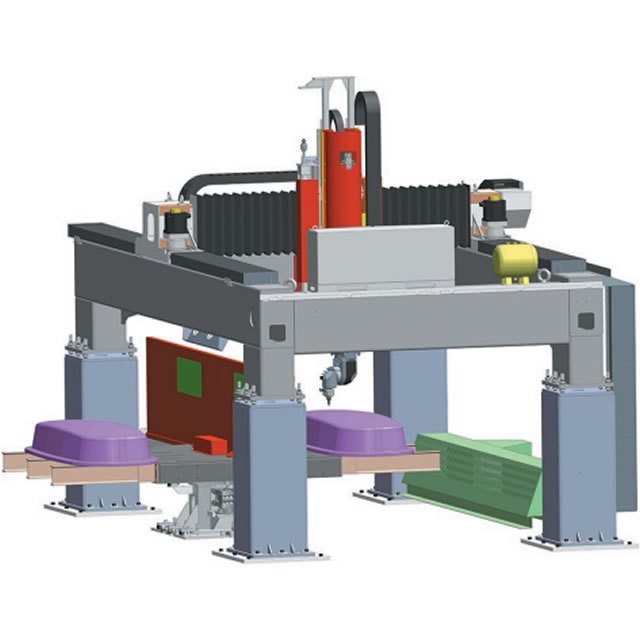
A formed shell may fit a linear envelope while its fixture, clamps or flange prevents the cutting head reaching an edge at the required angle. Show the highest feature, inward-facing surfaces, overhangs, clamp locations and the complete nozzle/head assembly.
Agree fixture datums, part location, clamp verification, approach/retract moves and permissible orientation changes. Check the loaded collision envelope and local head clearance through the actual path. Five-axis capability does not imply access to every contour or automatic correction of variable formed parts.
For repeated loading, define how springback, locating variation and part-to-part differences are detected and managed. Confirm the actual controller, head, programming/post-processing, fixture and handling package together.
For K and Z, compare the complete sheet cycle.
Send actual material grades/thicknesses, sheet sizes, the nest and remnant strategy. Ask the quotation to identify working area, usable boundaries, supported load, source power, cutting head and control revisions. The model code alone does not establish all of those values.
Distinguish a quoted single-table arrangement from an exchange-table arrangement. An exchange table can change when loading occurs, but table movement, clamps, collision zones and operator access still need review. Do not infer a cycle-time saving without timing the real loading, cutting and unloading sequence.
Include difficult pierces, corners, narrow parts, retention and part sorting. Define cutting gas, nozzle, focus, material condition and permitted edge rework. Motion speed is not the same as material-specific cutting speed or finished batch output.
Request the current revision instead of merging old tables.
The China product site could not be securely loaded during this review because its certificate had expired. The available search-reader copies remain reference material rather than proof of the configuration currently offered. These existing URLs are retained; current numerical build specifications are not inferred from another seller's variant.
The archived LD material also has inconsistent units in power or positioning rows. No unit is silently changed here to create a plausible specification. Request one signed current table naming the exact model, source/head/control, motion data with correct units, installed layout and supplied options.
The current issuer pages and dated annual report confirm company and broader manufacturing context, but do not establish the actual laser package, destination service response or accepted cut quality. Tie those responsibilities to the order and commissioning documents.
Use acceptance criteria that match the process stage.
Flat-sheet sample
Trial the actual nest and material. Inspect released part dimensions, hole/edge condition, burr or dross, distortion and sorting damage. Record loading, piercing, cutting, unloading, normal interventions and rework as separate cycle elements.
Formed-part sample
Trial representative formed parts in the actual fixture, including the difficult head orientations. Inspect trimmed edges and holes against the final part datums after release. Record locating variation, reclamping or recovery and the supplied program/post-processor revision.
Agree sample quantity, measurement datums, material condition and cooling/handling boundaries before the trial. Positioning and repeat-positioning figures describe machine motion under their stated conditions; they are not substitutes for accepted finished-part geometry.
For either route, include installation utilities, extraction, laser protection and access control in the supplied-system review. Name the team responsible for integration, operator training and recovery from interrupted cutting or loading.
Name the operating builder, not only the brand.
The FY2025 report issued through SGX lists World Precise Machinery (China) Co., Ltd. — 沃得精机(中国)有限公司 — as a subsidiary of World Precision Machinery Limited in its structure dated 31 December 2025. The issuer describes a Danyang manufacturing business in stamping machines and related components. This separates the operating company from the listed parent and other WORLD businesses.
Ask the quotation to name the legal seller and actual laser-machine builder, production/commissioning location and supplied-model documents. Where a dealer or another affiliate is involved, specify who provides installation, control/head support, spares and warranty service in the destination.
The current issuer product material includes JH21 and other press families, hydraulic shears and press brakes. Those families are broader company context here; no unreviewed machine records or certification badges are added to the retained laser catalogue.
Send the part in its actual process state.
State whether the job starts with a flat sheet or a formed part. Include drawings and datums, material/thickness, the nest or fixture, difficult edges/holes, batch mix and downstream operations.
Name the retained LD reference and request a current corrected build schedule, model-matched image, legal builder and a released-part trial. Include handling, occupied layout, utilities and destination support responsibilities.
Prepare a WORLD RFQ ↗