
 AMADA (CHINA) CO., LTD. · Shanghai regional headquarters
Punch or laser? Start with the features in the finished sheet.
AMADA's China catalogue spans punching, laser cutting, bending and supporting automation. For these three existing machine references, the useful decision is the part's holes, formed features, contours and next operation—not a power rating alone.
China company and model pages reviewed 8 October 2026; the selected ENSIS 3 kW brochure is dated September 2017
Send the folded drawing and the flat pattern together
Repeated holes, louvers or formed features
Start an AE-2510NT tooling review. A turret punch makes features with the installed punch/die set; it does not produce every formed feature simply because it has spare stations. Mark hole shape, pitch, forming direction, clearance and the surfaces that must remain free of clamp marks.
Changing contours and profiles
Start a laser-cutting trial with the material grade, thickness and edge requirement. VENTIS uses Locus Beam Control; ENSIS uses variable beam control. Neither produces a louver or bend by cutting its outline. Include the forming, bending, deburring or welding step that finishes the part.
These are procurement routes, not a claim that one process always wins. For a part requiring both cut contours and formed details, compare the complete route, datum transfer and handling. AMADA also lists combination machines and bending equipment; their capabilities are not assigned to the three models on this page.
AE-2510NT: check the tool list and sheet-handling sequence
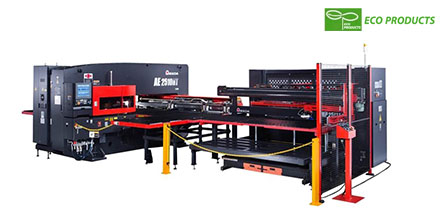
- Punching force
- 200 kN
- Maximum processing range
- 2500 × 1270 mm
- Turret alternatives
- 58 stations / 2 auto-index, or 45 stations / 4 auto-index
- Catalogue hit rate
- X: 350; Y: 280 per minute at 25.4 mm pitch and 5 mm stroke
The two turret entries are alternatives, not 103 combined stations. Map each hole/forming operation to the tool, station size and required auto-index position. Calculate the proposed blank's punching load and die clearance from its actual grade and thickness; the 200 kN force is not a universal maximum plate-thickness specification.
The page lists ±0.1 mm processing accuracy, or ±0.07 mm in FA mode, under AMADA's own standard. Agree hole-to-datum and formed-feature measurements on the drawing, with the selected tooling and sheet support. The catalogue hit rate excludes the full nest, tool changes and handling; accept good finished sheets over elapsed time instead.
For MP2512L, show incoming bundles, single-sheet separation, load position and completed-sheet stacking. Confirm available sheet sizes and masses, pallet capacities, safeguards and the intervention/recovery sequence in the proposed configuration. A successful short attended punch trial does not prove unattended operation for every oily, warped or mixed-thickness bundle.
AE-2510NT machine reference ↗Keep laser technology, power and catalogue edition together
| Configuration check | VENTIS-3015AJ | ENSIS-3015AJ · selected 3 kW reference |
|---|---|---|
| Beam-control approach | LBC controls the beam's locus for material and thickness | ENSIS adjusts beam shape; the linked brochure describes thin-to-thick processing |
| Rated laser power | 4000 W on the China model page | 3000 W selected from the September 2017 2/3 kW brochure |
| Processing envelope X / Y / Z | 3070 / 1550 / 100 mm | 3070 / 1550 / 100 mm |
| Material boundary | Page maxima: mild steel 16 mm, stainless 10 mm, aluminium 8 mm; prove the specified cut quality | Confirm a grade/thickness/process table for the supplied power. A brochure sample is not a universal thickness limit |
| Nozzle and automation scope | Page describes an eight-position automatic nozzle changer; agree loading system separately | Brochure includes several upgrade and option routes; identify supplied equipment separately |
| Buyer decision | Trial LBC on the edge, dross and part geometry you need | Fix the oscillator version and installed options before comparing the mixed-material trial |
Swipe the table horizontally on a small screen.
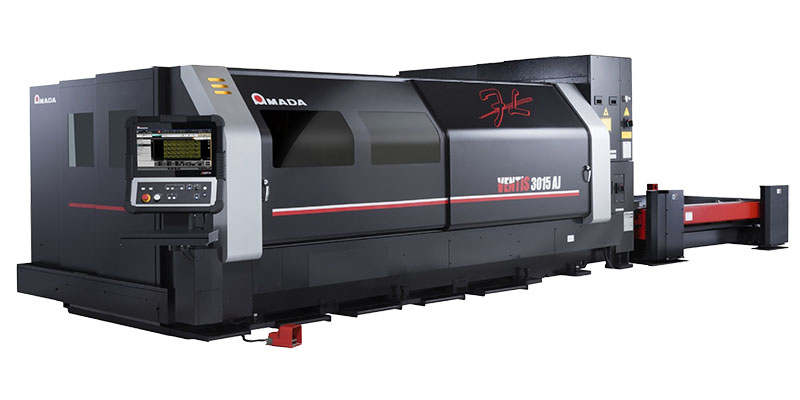
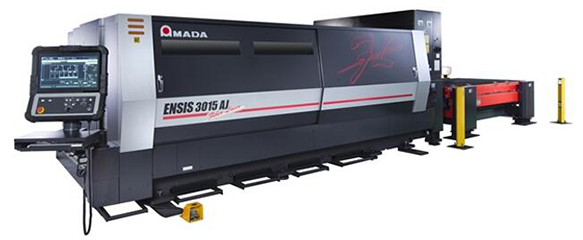
One family page contains more than one equipment generation
The ENSIS page introduces a 2 kW approach and links separate 3 kW and 6/9 kW brochures. This comparison uses its dated 3 kW brochure for the existing 3015 model. That document lists a 920 kg maximum workpiece weight for 3015; its 4020 entry has a larger envelope and different load. Do not combine the newer higher-power brochure, the 4020 load and an older 3015 image as one verified machine.
For a live quotation, specify the exact model, oscillator output, control version, material/thickness limits and installed automation. A historical model reference is a basis for questions, not confirmation of today's supply configuration.
Trial the sheet that the next operation can actually use
Freeze the inputs and required edge
Provide grade, thickness range, surface/coating condition and sheet flatness; small holes, slots, tight corners and heat-sensitive features; burr/dross allowance and whether an oxide-free edge is required for welding or coating. Agree assist gas, consumables and downstream cleaning. These are acceptance inputs, not assumed results.
Run a representative nest and material change
Include piercing, lead-ins, small-part stability, scrap removal, nozzle/tool changes and load/unload time. If mixed-material production is the purpose, trial the real changeover and recover a planned interruption. Record accepted parts and rejects alongside elapsed time, gas, tools and operator intervention.
Check after release, then through the next process
Inspect hole/contour position, edge and flatness after removing the part from the sheet. Trial critical bends or weld preparation using the agreed datums. Report cutting speed separately from finished-sheet cycle, and machine-axis inspection separately from part acceptance. A faster head movement does not fix a downstream edge or distortion problem.
Identify the China entity and the complete project handover
AMADA's China company page identifies AMADA (CHINA) CO., LTD. as the Shanghai regional headquarters, established on 16 April 2012. The group's wider offer includes sheet-metal equipment, cutting/grinding, presses and precision welding, with tooling, software and peripheral automation. The Japanese group's 1946 founding date is not the China company's incorporation date.
A Qingpu Commerce Commission 2021 regional-headquarters funding notice names the China entity. It supports historical entity context; it is not a machine certification, an audit of current production or evidence that every AMADA model is made in Shanghai.
Agree the supplying and destination-service entities, machine origin/version, tooling, CAM/nesting licence, postprocessor, loader interfaces and safety handover. Specify training, program backups, consumable availability and support responsibilities. For an automated route, include sheet storage, identification, nesting release and the finished-sheet destination in the acceptance scope.
Send the drawing, sheet mix and next operation
Attach the finished and flat drawings; material grades/thicknesses and surface condition; punched/formed features or laser contours; representative nest and monthly mix; edge, flatness and hole tolerances; next bend/weld/coating step; turret/tooling or exact laser power/version; loader/storage and software scope; destination and the agreed trial/acceptance method.
Send AMADA sheet-metal RFQ ↗