

Factory profile · precision machining
Guangdong Daqun CNC Machine Tool Co., Ltd.
A second spindle helps only when two real parts, fixtures and tool paths fit the same cycle. Start with the paired layout, then compare Daqun's S650-C and M640-L2.
Manufacturer catalog reviewed September 2026 · Profile reviewed October 2026
- Reviewed machines
- S650-C · M640-L2
- Deciding constraint
- Single setup or two matched stations
- Buyer should provide
- Part + fixture layout
Can both heads stay useful for the whole job?
A twin-head machine is a process decision, not an automatic doubling of output. Compare the operations and tooling required by each part. If one station waits or the fixture blocks a feature, the nominal second spindle does not solve the bottleneck.
| Route | Working envelope | Tooling | Question to settle |
|---|---|---|---|
| S650-C · one head | XYZ 500 / 400 / 250 mm; 600 × 500 mm table | 12- or 16-tool arrangements listed | Will one flexible setup reach every feature? |
| M640-L2 · two heads | XYZ 400 / 400 / 200 mm; 600 × 400 mm table | 16 or 20 tools total: 8 or 10 per head | Can two fixtures work within 365 mm head spacing? |
On a narrow screen, swipe the comparison sideways.
Head spacing is not the distance between two bare parts
For the M640-L2, place both stock shapes, clamps, holders and longest tools in one scaled layout. Its published 365 mm spindle spacing must accommodate both working zones through the full cycle; check enclosure and Z clearance too. The 600 × 400 mm table is rated to 100 kg, but this does not establish allowable fixture mass at every configuration.
- Map each operation to a head. Count unique tools per station. A 20-tool magazine does not give each head 20 tools.
- Show the worst interference position. Include clamps, probing, tool-change motion and part removal—not only the cutting position.
- Balance the cycle. Compare cutting, tool changes, loading and inspection for both stations; specify whether simultaneous work is required.
When one head is enough: The S650-C provides a larger published X and Z travel than M640-L2. That may be more useful than pairing for a tall fixture, varied small batches or a part needing more tool freedom; prove it against the actual drawing.
Two machines with different buying risks
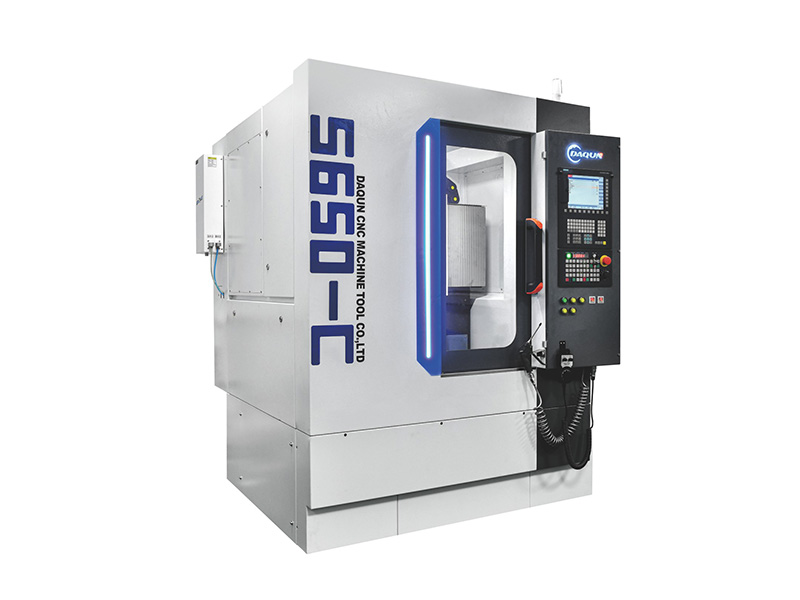
S650-C: fit the cutter and holder
The maker lists a mineral-cast structure, linear-scale feedback and 100 kg table load. Published 32,000, 36,000 and 40,000 rpm spindles, HSK-E25/E32/E40 holders and 12/16-tool arrangements are alternatives. Put one coherent configuration on the quote.
S650-C model details ↗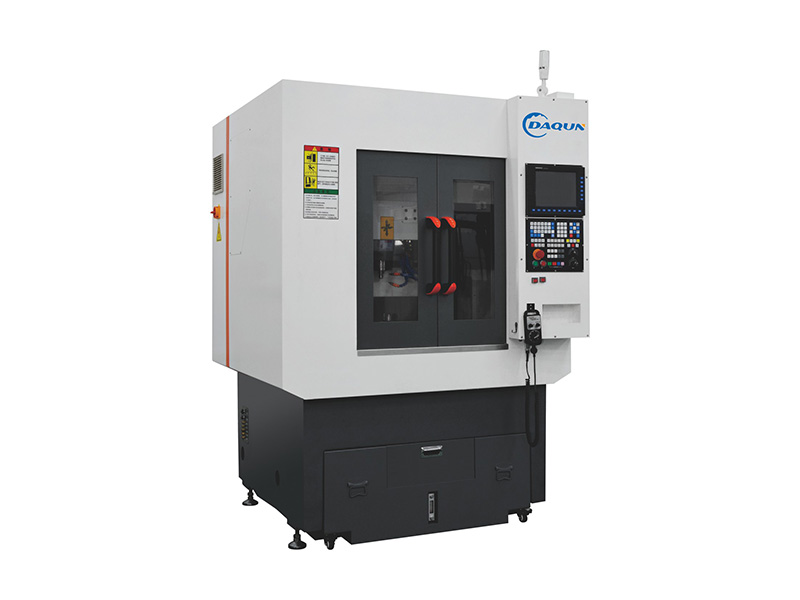
M640-L2: prove two stations together
The maker lists 36,000, 40,000 and 60,000 rpm spindle alternatives. No speed option alone establishes achieved surface finish or throughput. Ask for a two-part fixture plan and an actual simultaneous cycle before comparing production rates.
M640-L2 model details ↗Request a cycle breakdown, not a spindle demonstration
Use the drawing, material and stock from the intended production job. For a twin-head proposal, require two loaded fixtures, the head-by-head tool list, an interference review and measured parts from both stations. Record cutting, tool change, loading and inspection separately. Compare tolerance and finish after the same cycle; a short dry run cannot establish long-run repeatability.
The reviewed product pages identify Guangdong Daqun CNC Machine Tool; wider catalog references also mention a Jiangxi group company. Confirm which entity makes, sells, commissions and supports the exact machine in writing.
What this comparison can support
Named model dimensions, spacing, speed alternatives and tool-count variants come from manufacturer product records reviewed in September 2026. At this review, the earlier product link redirected to a maintenance page, so current availability and configuration must be reconfirmed with a dated offer. This is an editorial fit guide, not a witnessed production trial or independent certification. Private records retain the exact source-to-field mapping.
Make the fixture decision answerable
Attach the part drawing and these details through CNCVerified:
- Material, stock, finished features, tolerances and annual batch size.
- One- or two-part fixture sketch, clamp height and longest tool assembly.
- Expected operations per head, acceptable cycle and inspection method.
- Required spindle, holder, tool count, extraction/coolant and destination.