

北京迪蒙数控技术有限责任公司 · Beijing
DMNC EDM: choose by cavity or hole geometry
45S+PRO and HS-600 use different electrode and access arrangements. Compare the complete setup and required finished feature before comparing axis counts or maximum current.
Official company, both model pages and original parameter images reviewed 8 October 2026; parameter tables and company page re-checked 30 October 2026
Describe the feature you need to produce
A cavity formed by an electrode
For mold cavities, shaped recesses or other die-sinking work, start with the finished geometry, material and electrode design. 45S+PRO is a three-axis simultaneous die-sinking EDM model; its workpiece and electrode have separate load limits.
45S+PRO model and dimensions ↗A small hole at a defined attitude
For small holes with defined entry position and angle, compare the electrode path, rotary access and breakthrough requirements. HS-600 lists a 0.2–3 mm hole range, six controlled axes and five-axis simultaneous motion.
HS-600 hole-machining specifications ↗Do not choose either route from the word “EDM” alone. Send the material and feature drawing, including wall thickness and adjacent surfaces. Ask the supplier to explain the electrode, working medium, motion and process sequence proposed for that feature.
45S+PRO: check the entire immersed setup
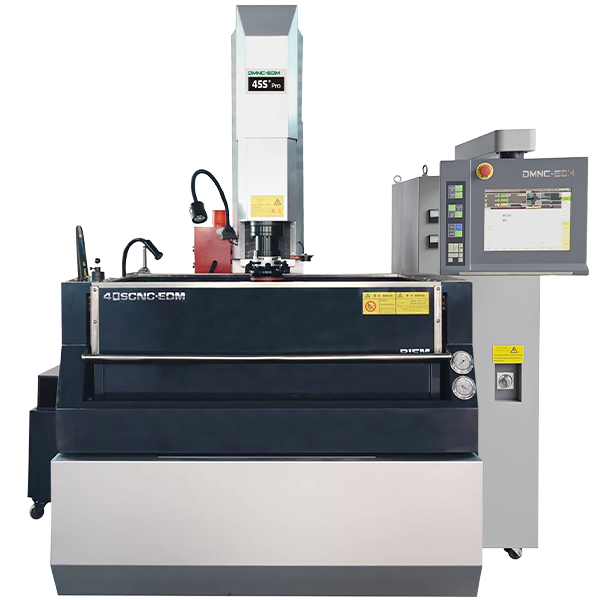
Three different spaces
- Machining travel X / Y / Z
- 450 / 300 / 320 mm
- Worktable
- 700 × 400 mm
- Tank interior
- 1200 × 680 × 440 mm
Table size is support area; axis travel is motion; tank size is surrounding space. None alone gives the maximum cavity, electrode assembly or workpiece height. Include the fixture, electrode holder and safe approach position in the setup drawing.
Build the setup from the table upward
- Support and fixture: show how the part is located and how clamping leaves the discharge area accessible.
- Part and liquid: add workpiece height and the required immersion. Maximum published liquid level is 290 mm, below the tank's 440 mm internal height.
- Electrode and holder: add holder length, electrode reach, approach/retract and changing clearance. The catalog's 585 mm table-to-ram lower-plate dimension needs its reference position confirmed on the machine drawing.
The maximum workpiece weight is 400 kg; the electrode limit is 25 kg. Confirm how the quotation defines fixture/holder mass and the loaded assembly. The tank is described as manual pull-down, so check loading equipment, operator reach and tank-opening clearance.
The Pro-series description uses a low, wide T-shaped bed, a cross-table arrangement and a counterbalanced single-column head. It names a granite worktable and precision guides/ball screws. These construction details are useful for reviewing thermal and motion behavior; acceptance still needs measurements on the ordered machine and your representative cavity.
The table lists 50 A maximum machining current, three-axis simultaneous control and a 590 L working-fluid reservoir. Agree the dielectric, filtration, temperature control, flushing and electrode-change arrangement with the application proposal. Maximum current does not establish fine-finish settings or removal rate for the actual material.
HS-600: prove access along the actual hole axis
HS-600's linear travels are X 600, Y 400 and Z 350 mm, with a separate W travel of 400 mm. B is −110° to +110° and C is 360°. The table is 900 × 500 mm with a published 500 kg workpiece limit.
Those motions establish a machine envelope, not the longest achievable hole. Show the entry point, axis direction, depth, neighboring walls and fixturing. Check the complete part/fixture sweep and electrode guidance at the most difficult attitude.
One hole definition needs six inputs
Diameter · depth · entry angle · entry location/datum · material/wall thickness · breakthrough/back-wall requirement.
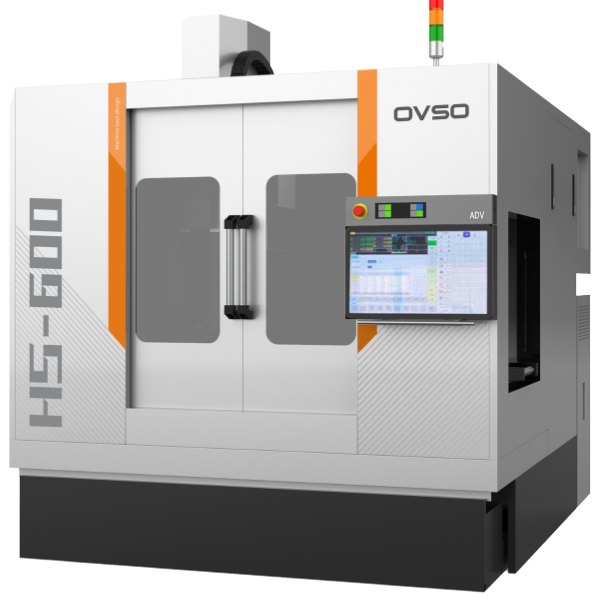
The official table gives a 0.2–3 mm hole-diameter range, deionized water and 50 A maximum machining current. Ask for electrode material, diameter, guide, wear allowance, automatic replacement and water-treatment requirements for the exact hole. Do not derive maximum depth or aspect ratio from W travel.
The control description supports imported DXF and NC programs, remote monitoring and automation interfaces offered to customer requirements. Include the postprocessor, rotary-axis conventions, program simulation and interface responsibilities in the order; named controller components do not prove compatibility with an existing production line.
The catalog's 0.001 mm linear command resolution is separate from its positioning/repeatability figures and from finished-hole diameter, taper or location. Where an angled hole meets a curved surface, define the entry position and inspection coordinate system explicitly.
Agree the process result before the demonstration
45S+PRO cavity trial
Use the agreed workpiece and electrode materials. Measure cavity dimensions, corner/detail reproduction and surface finish at named locations. Record electrode wear, any rough/finish electrode changes, flushing and total processing time.
HS-600 hole trial
Use the required thickness and angle. Inspect entry/exit diameter, taper, location and breakthrough. For sensitive adjacent walls, agree how unwanted back-wall damage and surface integrity are assessed, including any sectioning or specialist inspection.
Keep settings and conditions
Retain the program, electrode identification, discharge settings, fluid condition, fixture and measurement method. Repeat representative features to show consistency; a single favorable sample is insufficient to establish your production process.
45S+PRO's table publishes separate best-finish, minimum-wear and maximum-production figures. It does not establish that all those extremes occur together on your cavity; the roughness row also lacks a complete measurement definition. Specify the surface parameter, cutoff, sampling locations and agreed limits in the trial contract.
Include the supporting system in the quotation
Request the machine, electrode holders/guides, working-fluid and filtration system, consumables, electrical requirements, lifting/installation plan, training and process support. HS-600 lists 380 V domestic supply; confirm destination compatibility. 45S+PRO lists 2600 kg and 2560 × 2300 × 2306 mm machine dimensions; add access for fluid service and tooling.
A company focused on electrical-discharge processes
Beijing DMNC combines EDM equipment development, manufacturing and process work. Its official company description names multi-axis die-sinking EDM, precision micro-EDM, special-material process development and equipment/component testing. It describes a relationship with Beijing's EDM research organization and the Beijing Academy of Science and Technology.
An academy report published 15 August 2025 names the exact company among supporters and sponsors of the 3–5 August EDM technology seminar in Beijing. This dated research-community participation gives context to its EDM focus; it is not a certification of either machine or proof of a buyer's application.
The company also describes specialist shaped holes, difficult materials and closed-channel process development. Those broader research applications should be evaluated as separate proposals. This study's 45S+PRO and HS-600 figures do not establish every capability of the wider catalog. Purchasing and trial guidance here is CNCVerified's analysis of the reviewed sources.
DMNC's own map of its organization places research and development at a Beijing headquarters in Haidian and manufacturing at a plant in Beijing's Pinggu district, with demonstration centres in fifteen other cities including Shanghai, Kunshan, Ningbo, Chengdu and Dongguan. For a trial burn, ask which site would run it and whether it uses the machine type being quoted; a demonstration centre's result is not the acceptance test of your own unit.
Send the cavity or hole definition
Attach geometry, material, workpiece/fixture dimensions and mass. For cavities, include the electrode plan and finish target; for holes, include diameter, depth, angle and breakthrough requirements. Add inspection criteria, batch quantity and destination installation needs.
Prepare a DMNC RFQ ↗