

LEADCNC · Jinan, Shandong
Aluminum-profile production equipment
LEADCNC: from extrusion to identified finished part
A long-bed machining center and an integrated saw–mill line solve different production problems. Start with the profile cross-section, required operations and how the finished piece reaches assembly.
Company and exact model sources reviewed 8 October 2026
Where will cutting to length happen?
Emerald F260
Choose a four-axis profile center when mounting holes, drainage slots, lock openings, shaped holes or end milling are the main task. Establish how sawn stock arrives at the bed and how clamping makes every required feature accessible.
Review Emerald F260 specifications ↗Ultra X380
Consider integrated feeding, milling, drilling, sawing, end milling and unloading for curtain-wall profiles. The production question includes stock nesting, short-part handling and labels, rather than just an axis envelope.
Review Ultra X380 specifications ↗These are two reviewed examples from a wider catalog of window, door and curtain-wall equipment. A complete window-production line also needs the downstream operations specified for your product; neither model alone establishes a finished-window process.
F260: fit the section, clamps and tools together
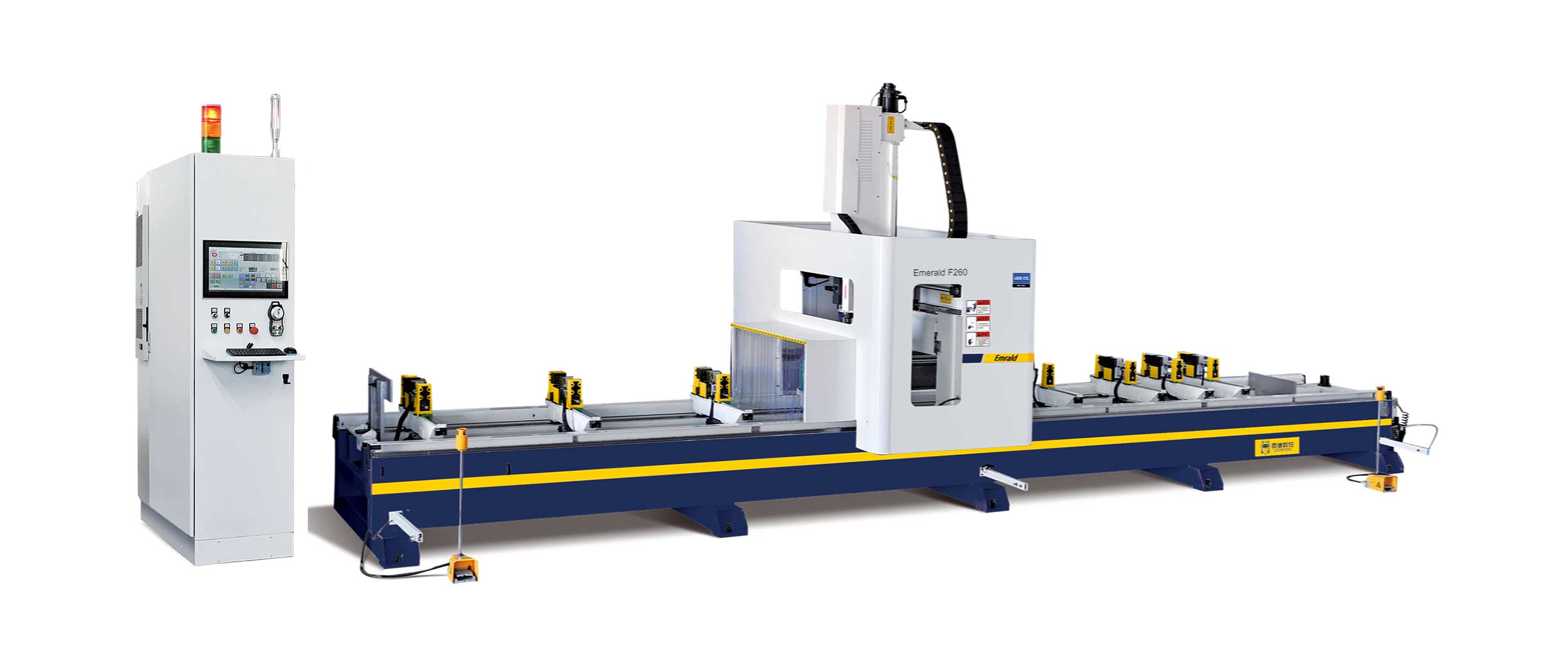
Length is a configuration choice
The catalog lists 7000 / 9000 / 12000 mm X travel, with Y 900 mm and Z 260 mm. Those travels do not define the maximum extrusion cross-section or the usable length in each working zone. Send the section drawing, part lengths and end features with the clamp layout.
A single published 9000 × 2740 × 2700 mm footprint and 4300 kg mass appear alongside three X-length choices. Obtain the installation drawing and mass for the exact version, including service access and incoming/outgoing stock space.
Published machining equipment
- Spindle
- HSD, 9 kW; description up to 24,000 rpm
- Rotation
- ±90°
- Magazine / clamps
- 9 tool positions / 8 clamps
- End-milling saw
- 80–150 mm diameter
The swiveling spindle can approach different profile faces. Ask for tool/holder clearance at the deepest feature and near every clamp, with the actual wall thickness and surface finish. Agree whether clamps must move during the program and how the datum is retained after movement.
The manufacturer describes dual working zones and infrared protection. For alternate loading, establish the length available per zone, the permitted operator access, interlocks and how a job is prevented from crossing an occupied zone. A dual-zone claim alone is not a safety assessment.
The feature text says running speed up to 60 m/min, while the X-travel table lists 0–90 m/min. Obtain the configured axis-speed schedule. Neither figure is an aluminum cutting feed or a promised number of parts per hour.
X380: plan the stock flow before the machine footprint
The distinction between raw and processed length matters: a 400 mm finished component is within the published processing range, but a 400 mm offcut is below the stated 1000 mm raw-stock minimum. Confirm usable remnants, kerf, end trimming and grip allowances before estimating yield.
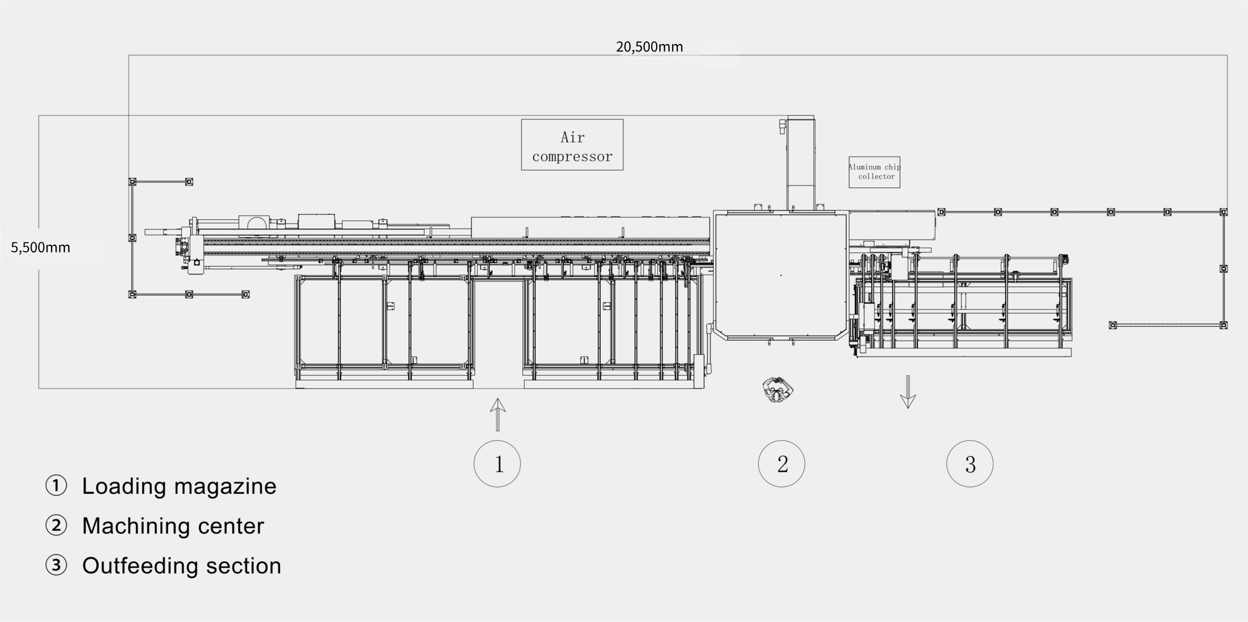
Section and processing boundary
- Published width / height
- 30–380 / 30–200 mm
- Milling equipment
- 6 spindles, 18,000 rpm
- Top and bottom pairs
- 13.5 + 6.7 kW per pair
- Front and rear
- 6.7 kW each, ±90°
Cutting and site services
- Sawing unit
- 600 mm blade, 7.5 kW
- End milling
- 400 mm blade, 3 kW, ±90°
- Supply / listed total power
- 380 V / 50 Hz; 56 kW
- Air / machine mass
- 0.5–0.8 MPa, 300 L/min; 16,000 kg
Six milling spindles are not six interpolating axes. The download title uses “five-axis”, while the current model heading describes a sawing and milling center. Quote the controlled motions and the supported operations for your drawing instead of assuming universal simultaneous five-axis machining.
The official page describes loading up to three profiles, automatic labeling and unloading. Demonstrate the actual mixed sections and lengths, how stock is gripped, which operations can overlap, and where rejected parts or remnants leave the line. Blade access and spindle count do not by themselves establish production throughput.
The job file must survive the move to assembly
Input
Send section drawings, hole/slot/end geometry, stock and finished lengths, quantity, material and finish. Define the reference end and profile orientation so mirrored parts cannot silently share the wrong program.
Machine handoff
LEADCNC describes ERP and barcode connectivity; F260 names PA control. Request the actual import format, compatible software/version, licensing, postprocessor, network responsibilities and recovery procedure. A connectivity statement is not proof your ERP can exchange jobs without integration work.
Output identity
For X380, agree the label fields and location: order, assembly position, orientation and part identifier as appropriate to your workflow. Demonstrate missing/duplicate scans, interrupted jobs and rework without losing the link between a physical extrusion and its production record.
Run the difficult extrusion, not only the easiest one
Choose a trial set containing the longest part, the widest/deepest section, a thin wall near a clamp, angled end work and the shortest finished component required. Include the actual coating and visible faces so scratches and clamp marks are assessed along with dimensions.
Inspect after unclamping
Measure hole positions, end angles and finished length using agreed datums and inspection methods. Check burrs, slot finish, deformation and fit with mating parts. F260's published positioning figures and X380's ±0.1 mm saw/end-milling figures are manufacturer data, not a guarantee for every finished section.
Time a representative order
Include program/data preparation, loading, clamp movement, machining, cutting, labeling and unloading. Record operator tasks, rejects and changeover between sections. Agree the mix and sample size before accepting a cycle-time target.
Commission at the destination
Confirm foundation/leveling, stock handling, electrical load and air quality/flow. F260 lists 16.5 kW and 60 L/min air; X380 lists 56 kW and 300 L/min. Add chip collection and other peripherals explicitly, then agree installation, training, spares and software support in the quotation.
LEADCNC's focus is aluminum-profile production
LEADCNC supplies independent profile-processing machines and connected production equipment from Jinan, Shandong. Its English company history dates its founding to 2007 and describes developments in aluminum sawing/processing and software-connected lines. Its Chinese company site identifies 山东雷德数控机械股份有限公司 and presents window/door intelligent-production and supporting-equipment series.
The wider catalog includes intelligent window/door production lines and supporting equipment. For a complete line, ask for the equipment list, buffer positions, downstream assembly interfaces and the responsibilities for commissioning each connection. Evaluate the proposed line against your production mix and available operators.
For X380 installation, use the loading, processing and outfeeding arrangement shown above to plan material routes. Request an identified configured-machine photograph and final installation drawing with the order; confirm conveyor lengths, peripheral positions and maintenance access against the actual site.
The selection and acceptance guidance above is CNCVerified's purchasing analysis of the reviewed manufacturer material. Confirm the contracting entity, configured equipment and service scope in the RFQ.
Request a profile-processing proposal
Attach your extrusion sections and finished-part drawings. Include stock lengths, machining faces, tolerances, finish, batch mix, desired job-data connection and destination utilities. State whether cutting to length is upstream or must be included in the equipment.
Request a LEADCNC quote ↗