

PAMA · Manufacturing operations in Italy and Shanghai
PAMA: choose the route for a heavy workpiece.
Compare horizontal Speedmat HP with vertical Speedmat VM. Milling and mill/turn builds have different table loads; select one head, fixture and duty before comparing capacity.
Choose the machining route ↓Prepare a PAMA RFQ ↗
Company and November 2022 family sheets reviewed 8 October 2026
Where must the cutter enter the loaded workpiece?
PAMA's range extends from horizontal boring and milling through machining centres and gantry machines. For the two Speedmat references below, begin with the faces and deep features that must be reached, the rotating fixture envelope and the operations that must stay in one datum.
Horizontal access · Speedmat HP
The T-type architecture combines a moving table, moving column and centrally mounted headstock. A side-access feature, deep bore or housing can lead to a fixed horizontal H head, tilting head or a W/WD boring spindle. A projecting boring spindle adds a separate extension and stiffness question; it is not merely more Z travel.
Examine Speedmat HP ↗Vertical access · Speedmat VM
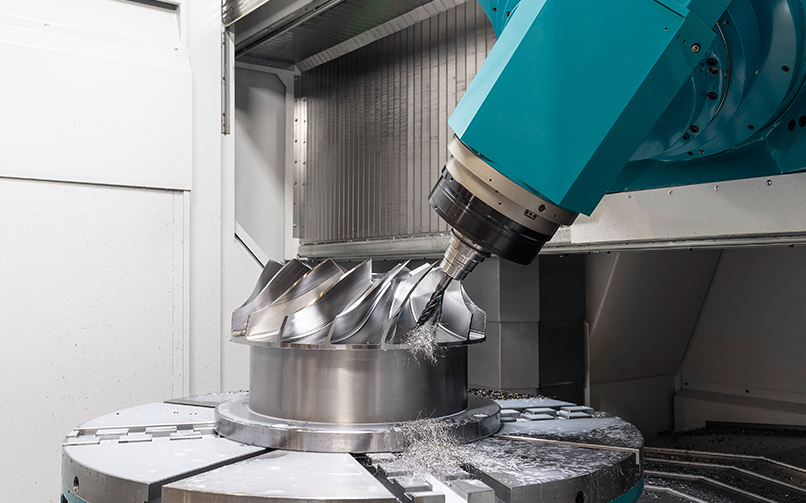
A fixed portal, moving crossrail and rotary table arrange the cut from above. HVA or A tilting heads offer different approach routes around the workpiece. Check the tilted holder sweep, fixture height and clearance to the portal/crossrail for the actual head and blank; a published swing diameter does not describe every tilted cutting position.
Examine Speedmat VM ↗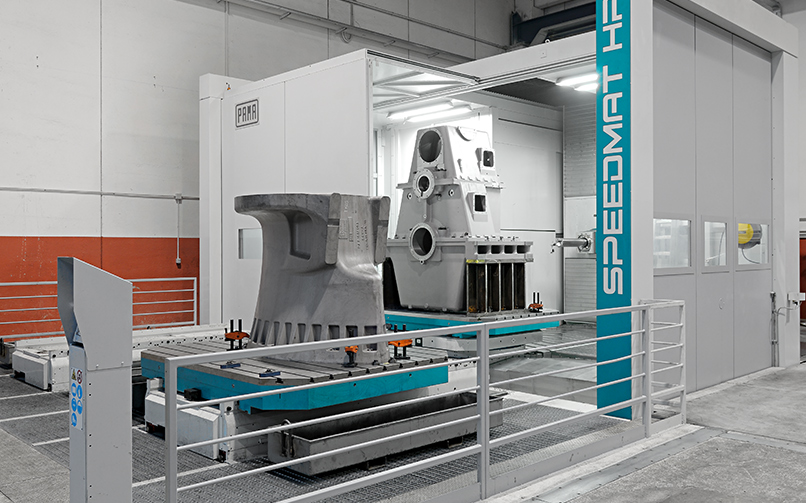
Milling capacity and turning capacity belong to different builds
The November 2022 English sheets report ranges across HP1–HP7, HPT1/2/3/5 and VM/VMT1–3. The figures below describe those families. Request a single selected build with one table, head, travel set and load diagram; the largest values are not a package available on every size.
On a small screen, swipe across the four routes; the check label stays visible.
| Decision | HP · milling | HPT · mill/turn | VM · milling | VMT · mill/turn |
|---|---|---|---|---|
| X travel range | 2200–4600 mm | 2200–3800 mm | 1700–2700 mm | 1700–2700 mm |
| Y / Z ranges | 1700–3500 / 2000–3200 mm | 1700–3000 / 2000–3200 mm | 1500–2700 / 1300–1700 mm | 1500–2700 / 1300–1700 mm |
| Swing diameter range | 2200–4600 mm | 2200–3800 mm | 1500–3000 mm | 1500–3000 mm |
| Table / pallet range | 1000 × 1000 to 2000 × 2500 mm | Ø1250–2500 mm | 1000 × 1000 to 2000 × 2000 mm | Ø1250–2200 mm |
| Published family load ceiling | Up to 35,000 kg | Up to 15,000 kg | Up to 12,000 kg | Up to 8000 kg |
| Turning-speed ceiling | No turning build implied | Up to 350 rpm | No turning build implied | Up to 350 rpm |
Round blank with milling and turning features
Consider HPT or VMT when the drawing benefits from retaining the same setup for turning and milling. Include eccentric mass, chuck/fixture, tool clearance and allowable rotating load. Ask for a load/speed envelope and balance requirements for the selected table. A 35 tonne HP milling-family ceiling cannot be carried into a 350 rpm HPT turning claim.
Heavy prismatic part with no turning requirement
Start with the HP or VM milling arrangement and accessible faces. Determine whether head changes or pallet rotation reach those faces without a second setup, and include those motions in the cycle. A turning table can add capability and constraints; select it because of required operations rather than using it as a generic upgrade.
Select a head and compare the same motor duty
Fixed horizontal or extending boring spindle
The HP H-head reference is direct drive, 94 kW and 1793 Nm at S1, with a 5000 rpm speed ceiling. The W-head range uses two transmission ranges and a 130–160 mm boring spindle with 800 mm W stroke; WD is a direct-drive boring alternative. Confirm the actual spindle diameter, extension, bearing arrangement and tool reach for a long bore. Those heads are alternatives, not cumulative axes and power ratings.
Tilting approach with HVA or A head
The HP HVA sheet pairs 74 kW S1 with 609 / 286 Nm and 8000 / 12,500 rpm variants. The VM HVA/A sheet instead gives 84 / 85 kW and 901 / 450 Nm at S6-40%, with 8000 / 12,500 rpm variants. These duty labels differ. Obtain continuous-duty torque curves for the selected spindle before comparing a long roughing cut with an intermittent published rating.
The VM sheet separately lists HVA A-axis contouring torque 4000 Nm and clamping torque 8000 Nm; the A head lists 5000 and 10,000 Nm respectively. Clamping torque is a stationary holding reference, not simultaneous-contouring capability. Ask which operations use indexed clamping, which require interpolation, and how the complete tilted tool/holder envelope is validated.
Plan the pallet, head and tool exchanges around the real cycle
PAMA describes pallet systems, automatic tool exchange and attachment-head exchange as configuration possibilities. It also describes sensor/software functions for unattended machining and maintenance support. Establish which equipment, interfaces and recovery procedures belong in the quotation.
Load and locate
Specify the pallet, fixture, loaded mass and centre of gravity. Check loading access, datum repeatability after exchange and rotary sweep with hoses, clamps and inspection equipment installed.
Exchange and cut
Map the complete tool set, head changes, retract positions and measuring steps. Include transfer, spindle warm-up, head calibration, chip clearing and probing in elapsed time; cutting feed alone is not production output.
Recover and release
Agree responses to a broken tool, interrupted head exchange, lost datum or coolant/chip fault. Define operator access, safe restart and inspection before the next released part. Demonstrate the proposed unattended interval on the actual process rather than assuming an automatic changer establishes it.
Agree the supplying entity, build site and final acceptance
PAMA's company page describes production sites in Rovereto and Brescia, Italy, and Shanghai, China, with the Shanghai operation directed to the local market. Nidec's 2 February 2023 acquisition announcement records PAMA S.p.A., its 1926 foundation and manufacturing/sales bases in Italy and China. This is a dated corporate record; it does not assign a particular machine to a particular factory.
Confirm the entity issuing the quotation, selected manufacturing/assembly site, model revision and responsibility for application engineering, installation and service at the destination. The family sheets reviewed here are marked November 2022. Obtain a current signed configuration and drawings rather than treating an older family range as the delivered build.
For acceptance, choose a representative workpiece and material condition with drawing datums, critical bores/faces, finish and inspection method. Record the head/table arrangement, tools, fixture, thermal sequence, head/pallet exchanges and full cycle. Inspect the released part after unclamping where the drawing requires it. Then agree foundation, lifting, utilities, commissioning and a repeat of the defined checks at the destination; neither the load ceiling nor a head torque figure guarantees that outcome.
Send the workpiece and the required machining sequence
Include material/heat treatment, drawing datums and tolerances, blank/fixture mass and envelope, centre of gravity, faces and deep bores, milling/turning requirements, proposed head and tool list, pallet strategy, complete cycle target, inspection/thermal sequence and destination. Ask for one selected configuration, a current load/speed diagram and an agreed trial.
PAMA RFQ ↗