

大连瓦机数控机床有限公司 · Changxing Island, Dalian
Dalian Waji: support the heavy blank before choosing the turning capacity
Compare the 1250 mm and 1600 mm single-column references by loaded table, ram reach and drive. A larger cutting diameter does not settle fixture support or tool access.
Original company and model specifications, plus a dated financial disclosure, reviewed 8 October 2026
Start with the casting, clamps and table support
Waji's catalogue covers conventional and CNC single-column and double-column vertical lathes. For a disc, ring or tall housing, start with blank diameter, height, total supported mass and centre of gravity. The two single-column specification sheets below describe particular suffix builds; their cutting diameters are larger than their table diameters. Check how the actual overhanging blank is supported and restrained before selecting capacity.
On a phone, swipe the comparison sideways. The full build suffix matters.
| Original build reference | CK5112F×12/3 ↗ | CK5116F×12/5 ↗ |
|---|---|---|
| Maximum cutting diameter / height | Ø1250 / 1250 mm | Ø1600 / 1250 mm |
| Table diameter / workpiece mass reference | Ø1000 mm / 3200 kg | Ø1400 mm / 5000 kg |
| Horizontal / vertical ram travel | 850 / 850 mm | 1000 / 1000 mm |
| Table drive / speed | Two mechanically selected ranges, stepless; 6.3–200 rpm | 16 steps; 5–160 rpm. Two-range stepless drive offered separately. |
| Tool arrangement described | Square ram; 32 × 32 mm tool shank | Electric turret; 40 × 40 mm tool shank. Confirm station count. |
| Main motor / approximate machine mass | 37 kW / 10,000 kg | 30 kW / 13,000 kg |
These are the manufacturer's particular technical references, not interchangeable limits for every CK5112F or CK5116F order. Include chuck jaws and fixture mass in the load assessment and ask for the permitted offset and clamping method. A machine mass figure is not the floor or foundation load calculation.
Separate ram cutting travel from crossrail repositioning
Reach the full profile
The two sheets list a 1000 mm crossrail movement and 660 mm/min raising speed separately from the ram's vertical cutting travel. Crossrail repositioning is not an extra interpolated Z stroke. Get a section through the loaded setup showing the beam position, tool projection, deepest bore, shoulders and tool withdrawal.
For an internal taper or deep cylindrical bore, check the holder stiffness and clearance at both ends of the profile. A maximum workpiece height does not prove that one tool can cut the entire height without resetting.
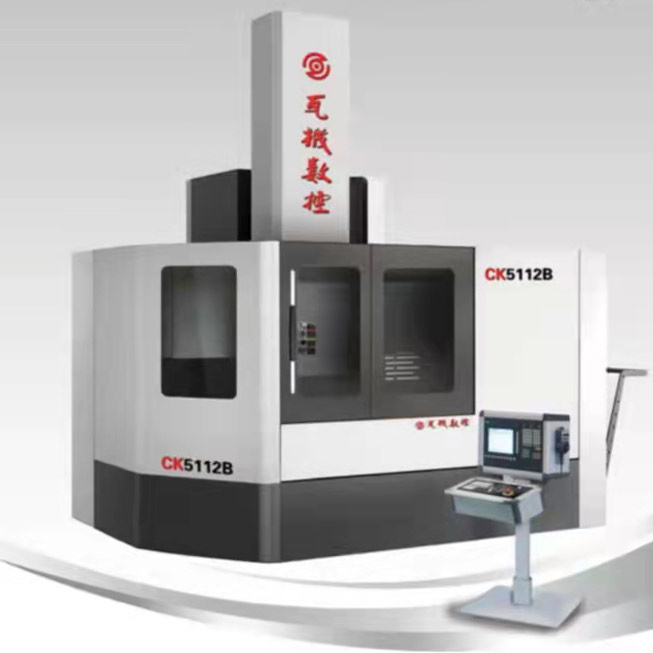
Choose the turning function with the actual drive and tool carrier
- Constant surface speed and threading
- The single-column introduction offers stepped and stepless drives. The CK5116F specification makes constant surface speed conditional on the stepless option; its standard speed table describes 16 steps. Ask for the installed spindle encoder, control functions and speed/torque curve for the intended thread and changing diameter.
- Square ram versus electric turret
- The 12/3 reference describes a square ram. The 12/5 text alternates four- and five-station turret descriptions. Put the exact carrier, occupied tools, shank size, index sequence and interference drawing on the quotation. Do not assume simultaneous cutting or milling from the presence of a turret.
- Lubrication and table support
- The sheets describe hydrodynamic table guideways, adjustable double-row cylindrical roller bearings and timed lubrication for ram sliding guides. That is not a hydrostatic-table claim. Agree oil, warm-up, low-speed heavy-cut conditions, adjustment procedure and chip protection with the actual build.
The double-column page contains separate 2500 mm and CK5231F×20/10 references, with different tool-carrier arrangements and control descriptions. A second column or second carrier alone does not establish two independently programmed CNC heads. For a larger blank, request its own build sheet and machining sequence rather than scaling the single-column numbers.
Prove the released ring or housing, not just table runout
Load the actual mass and restraint
Provide the casting condition, machining allowance, fixture support and clamp pattern. Define lifting and centring, then trial the rough cut at the intended diameter and overhang. Record vibration, chip clearing, tool wear and the time needed to reset the beam or tools.
Turn the difficult feature
Include the deepest bore, interrupted cut or taper and any thread. Confirm the selected drive and encoder function in that operation. The manufacturer's testpiece finish and geometric inspection references are not a promise of the same result on every casting.
Release and measure the datums
Inspect agreed bore/face relationships, roundness, flatness and finish after unclamping where clamp stress matters. Record material temperature, inspection method and the complete loading-to-accepted-part cycle. Keep machine positioning checks and finished-part acceptance as separate records.
Use the current supplier identity and a build-specific installation plan
The company page identifies 大连瓦机数控机床有限公司 in Dalian's Changxing Island industrial area. Its original wordmark retains historical Qier group branding. Shenyang Machine Tool's 2024 half-year report, page 129 explicitly connects the current and former Qier-named entities and records an April 2023 equity change. The report says the company was no longer within the referenced consolidation scope and was no longer identified as a related party at June 2024. Historical branding must not be read as proof of current group ownership.
Before ordering, align the legal name on the quotation, manufacturing responsibility and warranty with the selected machine. Ask for lifting points, transport splits, foundation loads and drawings, lubrication/electrical documentation, access for beam maintenance and the destination power/control language. The catalogue's domestic response claims do not establish an overseas installation or repair commitment.
Send the loaded blank and the hardest turning feature
Include blank diameter/height, material and allowance, fixture CAD, loaded mass/centre of gravity, clamp pattern, deep-bore and tool projections, drive/thread requirements, carrier/tool map, released-part datums and finish, full-cycle target and destination. Request the exact suffix build, a matching photograph and installation/acceptance documents.
Waji RFQ ↗