

GROB Machine Tools (China) · 格劳博机床(中国)有限公司 · Dalian
Keep the datum. Decide whether the part also needs turning.
G350 five-axis milling and G350T mill-turn share linear travels, but their rotating envelopes, load limits and spindle interfaces differ. Choose the operation first, then prove the mounted part fits.
Choose the machining route ↓Prepare a GROB RFQ ↗
Company and dated entity material reviewed 8 October 2026; G350/G350T specification panels and the interpolation-turning option rechecked 12 October 2026; GROB sites page and G350T panel re-checked 30 October 2026
Start with the surfaces that must stay related
Faces, pockets and freeform surfaces
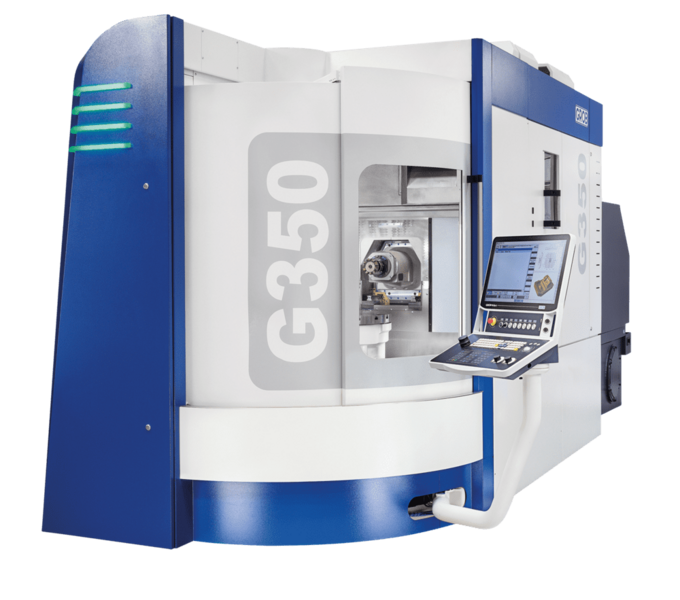
Use G350 as the milling reference where tilting the fixture provides access to multiple faces or simultaneous five-axis paths. Its horizontal spindle and retracting tunnel arrangement are intended to help tool access and chip fall. These features do not remove the need for a holder-and-clamp collision study.
G350 milling profile ↗Turned and milled features in one setup
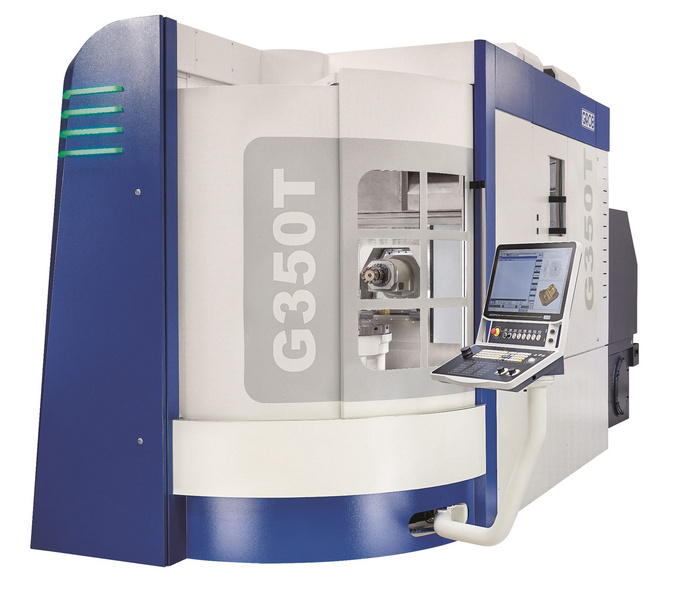
Use G350T as the mill-turn reference when a rotational feature must remain related to a milled datum. Its purpose-built turning table and HSK-A/T63 spindle configuration differ from the milling package. Define the rotating blank, fixture retention and safe turning conditions; adding a turning software option to a milling quotation does not prove the same hardware scope.
G350T mill-turn profile ↗A third route to ask about: the G350 catalogue lists Interpolation turning PLUS as a software option. This may be relevant to prototype or small-series rotational features, but the option does not establish the G350T turning table's 1,200 rpm specification or identical turning performance. Put the actual feature, control/software package, tool path and inspection target into the quotation; do not choose from the milling or mill-turn label alone.
First identify which datum transfers or re-clamping operations the proposed route actually removes. If the drawing only needs indexed access, request that route. If it requires simultaneous motion or turning, specify the operation and acceptance feature explicitly. “Five axis” alone does not describe all three jobs.
Same stroke. Different space for the rotating setup.
Swipe the table on a phone. Load order is deliberately written out because the two manufacturer pages present it differently.
| Exact model reference | G350 | G350T |
|---|---|---|
| X / Y / Z travel | 600 / 855 / 750 mm | 600 / 855 / 750 mm |
| Interference diameter | 720 mm | 620 mm |
| Table diameter | 570 mm | 570 mm |
| Load without pallet | 400 kg | 350 kg |
| Load with pallet | 340 kg | 270 kg |
| A / B rotary motion | 230° swivel / 360° | 230° swivel / 360° |
| Spindle reference | Standard HSK-A63 / 12,000 rpm / 83 Nm | Listed HSK-A/T63 / 16,000 rpm / 206 Nm |
| Turning-table B speed | No turning-speed claim here | 1200 rpm maximum |
| Linear maximum speeds | 70 / 45 / 90 m/min | 70 / 45 / 90 m/min |
Use the fixture, pallet and tool-fit checklist to prepare the complete mounted assembly before comparing the load columns.
Check the mounted blank, fixtures, protruding clamps and complete tool assembly over the required A/B motion. The interference diameter is different from table diameter and linear travel. A pallet changes the load limit; include every component the supplier’s load definition requires and obtain permitted centre of gravity and inertia. G350T’s maximum B speed is not a safe speed for every unbalanced blank or clamping arrangement.
Quote one machine package and one automation boundary
- Spindle and turning interface
- G350 lists separate HSK-A63 packages: 12,000 rpm/83 Nm, 16,000/206, 18,000/47, 21,000/47 and 30,000/63. They are alternatives, not one combined performance curve. G350T’s spindle-version section lists HSK-A/T63, 16,000 rpm and 206 Nm. Its application examples show other packages; do not transfer an example’s spindle to the delivered machine without confirmation. Request torque, duty, coolant and complete-tool compatibility.
- Magazine and long assemblies
- The single-disc limit is 365 mm for each model’s specified interface. The double-disc entries are 365/180/550 mm for bottom/top/over both discs. A 550 mm assembly does not fit every position or leave the same capacity. Obtain the occupied-tool layout, mass/diameter limits and usable remaining slots, including sister and turning tools.
- Control, pallet and production cell
- The pages describe GROB4Pilot with Siemens 840D sl or Heidenhain TNC 640, software options, pallet storage and tailored handling. Select the actual control, postprocessor, simulation, probing and software scope. Pallet clamping, storage positions and robot handling are separate choices. Define loading, cleaning, seating, tool-life management, inspection and recovery before accepting an unattended-production claim.
G350 lists 15,300 kg without a pallet changer or 17,500 kg with one; G350T lists 15,500 kg. Obtain the selected machine/cell installation plan, utilities, foundation, lifting and maintenance access. These mass references do not describe every automation layout.
Prove the datum chain with the actual complete route
Keep the hardest relationship on the trial drawing
Choose features relating opposite faces, a deep pocket or a turned bore to the milled datum. Identify which are indexed, simultaneous or turned. Trial the production material and fixture with the intended cutter/holder lengths. Include any unavoidable re-clamping and its measurement chain.
Inspect after the real thermal and clamping sequence
Agree gauge capability, measurement uncertainty, temperatures, sample size and the released-part condition. The published 0.006 mm linear positioning reference is a machine characteristic, not a guarantee for every finished feature. Kinematic calibration and in-machine probing require their own agreed routines and checks against the acceptance method.
Run the pallet and turning transitions
For pallet work, verify cleaned seating, repeat loading and part identification. For turning, verify retention, balance and approved speed with the supplier before the trial. Time the entire accepted-part sequence. The listed 2.7 s chip-to-chip reference under VDI 2852 is speed-dependent and does not establish production cycle, yield or tool life.
Dalian identifies the company, not every model’s manufacturing origin
GROB’s current sites material identifies GROB Machine Tools (China) Co., Ltd. in Dalian, and its company material describes the Chinese production operation. A 20 May 2024 Liaoning administrative notice separately identifies 格劳博机床(中国)有限公司 in Dalian. That dated record supports the entity cross-check; its radiation-licence subject is not a machining-centre quality certificate.
GROB’s own sites page lists the Dalian plant as opened in 2012, with 57,400 m² of production area and 1,230 employees, second only to Mindelheim among the production sites listed there. Those figures describe the plant’s scale; they do not say which machine types it builds.
The two model pages are group catalogue references. Confirm the quoted serial unit’s manufacturing site, contracting entity, configuration and acceptance location. Do not assume every group model or spindle variant is produced in Dalian. Production-system and electromobility offerings also need their own project evidence and scope.
Agree destination installation, training, control/postprocessor support, spindle service, spares and response terms for the actual purchase. A global network or service menu does not establish a specific warranty or local response time. Keep machine acceptance and combined-cell acceptance assigned to named contractual responsibilities.
Send the datum relationship and the rotating assembly
Include part CAD/drawing, material and blank, the linked milled/turned acceptance features, mounted envelope and mass/inertia, clamps and pallet, complete tool list, indexed/simultaneous/turning operations, proposed spindle/control, postprocessor and inspection method, automation scope, accepted-part run target, installation destination and manufacturing/delivery responsibilities.
GROB RFQ ↗