

苏州市宝玛数控设备有限公司 · Suzhou, Jiangsu
Baoma: choose the discharge process before the machine size.
A through contour, a small starter hole and a blind cavity need different electrode paths. Compare wire access, drilling depth and cavity tooling before selecting a Baoma EDM package.
Three current manufacturer model tables and the national standards platform reviewed 8 October 2026
What has to be removed—and can the electrode reach it?
| Feature on your drawing | Relevant Baoma reference | Decision that comes before size |
|---|---|---|
| A through profile, slit or tapered contour | BMA400C wire EDM ↗ | Wire entry and exit, starter hole, slug support and the angle through the actual workpiece thickness. |
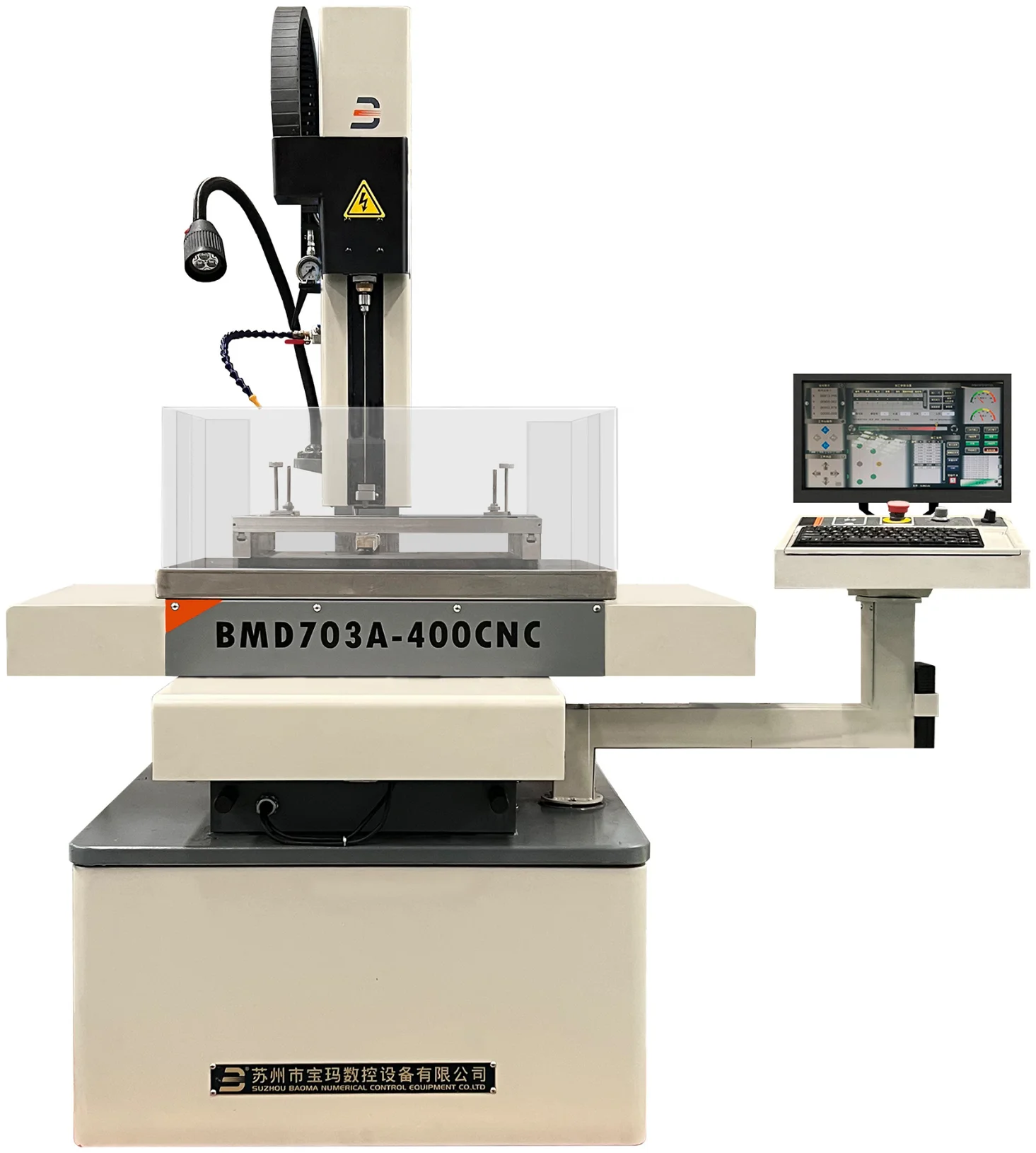
| A small deep hole or wire-start hole | BMD703A-400CNC hole EDM ↗ | Electrode diameter, usable drilling depth, flushing and whether breakthrough or a controlled blind end is required. |
| A blind shaped cavity | EDM450ZNC die-sinking EDM ↗ | Electrode geometry and access, the ZNC control boundary, and the rough/finish electrode sequence. |
On a narrow screen, scroll the comparison sideways or focus it and use the arrow keys.
Electrical discharge requires a suitable electrically conductive workpiece and a compatible electrode, generator and dielectric process. Send the material grade and heat-treatment state, not just “steel” or “titanium.” A geometric envelope alone cannot establish surface integrity, taper accuracy or production output.
BMA400C: thickness and taper belong together
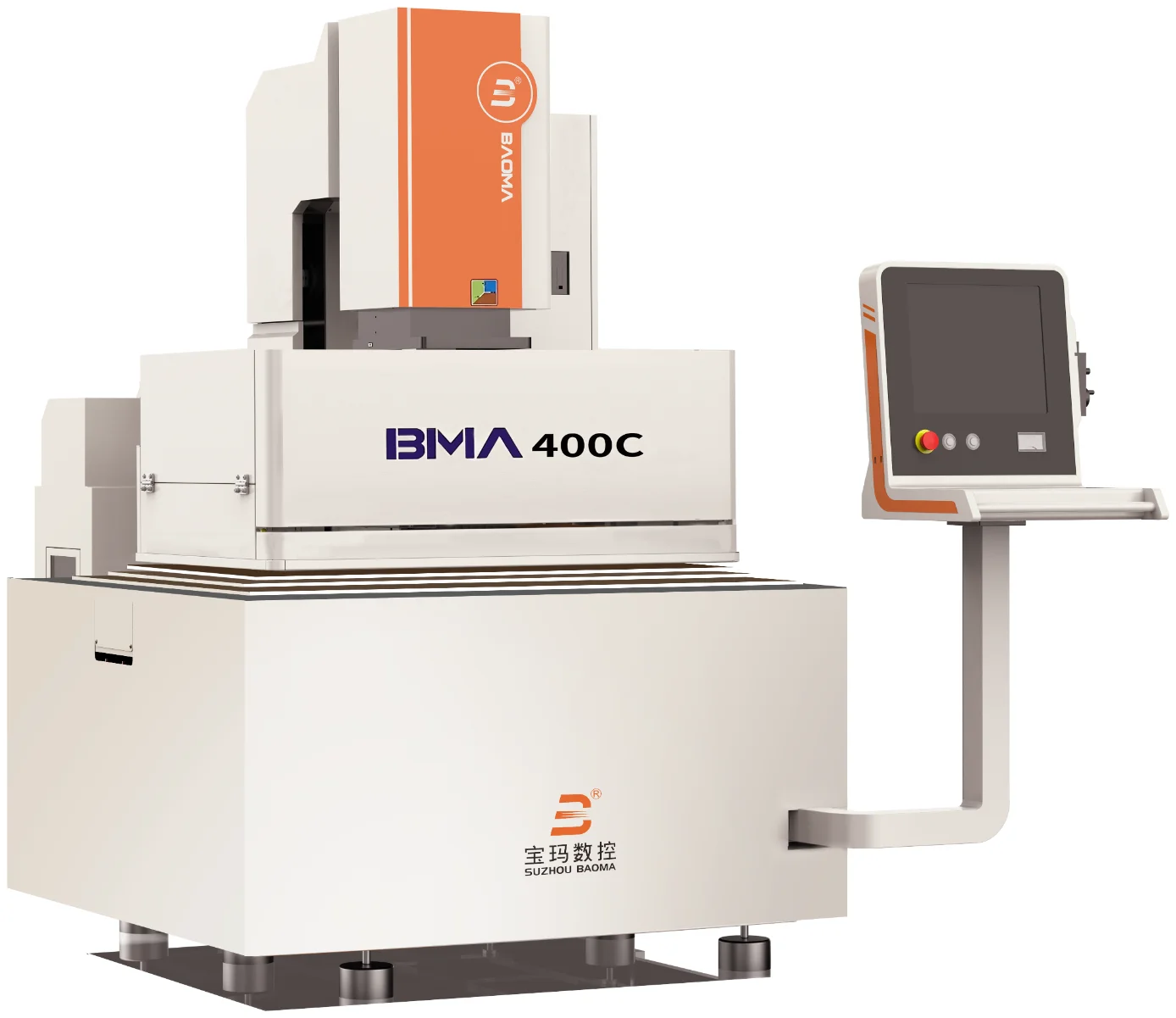
- X/Y and U/V travel
- 400 × 320 mm; 50 × 50 mm
- Table / supported load
- 650 × 420 mm / 400 kg
- Listed maximum thickness
- 300 mm
- Listed taper condition
- ±10° within 100 mm thickness
The 300 mm thickness entry does not extend the ±10° condition to a 300 mm part. Draw top and bottom contours, guide positions and the supported slug. Include clamp height and any taper direction that places the wire near a fixture.
The current model description specifies AC-servo control, a BMW8000 cabinet, bidirectional automatic wire tension and AR inclination correction. Its five-axis designation describes the wire machine; it is not a five-axis milling spindle. Aluminium cutting equipment is listed as optional, while titanium processing and AR correction are listed as standard. Put the material-specific arrangement on the quotation.
How to use the published accuracy, roughness and speed figures
The manufacturer table lists accuracy ≤±0.003 mm, best roughness 0.6 μm and peak removal area 350 mm²/min. These describe different results, not one guaranteed simultaneous operating point. Agree the specimen material/thickness, wire, dielectric, number of cuts, measurement positions and acceptance after release. Record rough and trim-cut time together with threading, support and slug removal.
BMD703A-400CNC: a long axis stroke is not the drilling depth
The current table gives a 510 × 320 mm worktable, X/Y travel 400 × 300 mm and a 300 kg supported load. Its Z entry is 300 + (300) mm, with an electric secondary stroke; its separately stated machining depth is 0–300 mm. Do not add the two Z figures and call the result a 600 mm hole.
The electrode clamping range is Ø0.2–3.0 mm. That range does not specify the final bore diameter, cylindricity or length-to-diameter capability in your material. Supply hole diameter, depth, axis direction, entrance/exit geometry and the permitted breakthrough burr or blind-end condition. The listed 50–60 mm/min maximum rate depends on material and electrode; time the entire hole, including electrode wear, flushing and replacement.
Z depth control, a probing rod and external spray are listed as standard. The filter tank and automatic electrode change are optional. The model is described as three-axis CNC; a separate fourth-axis entry contains a dash, so a delivered rotary package must be confirmed rather than inferred.
EDM450ZNC: start with the electrode and the control boundary
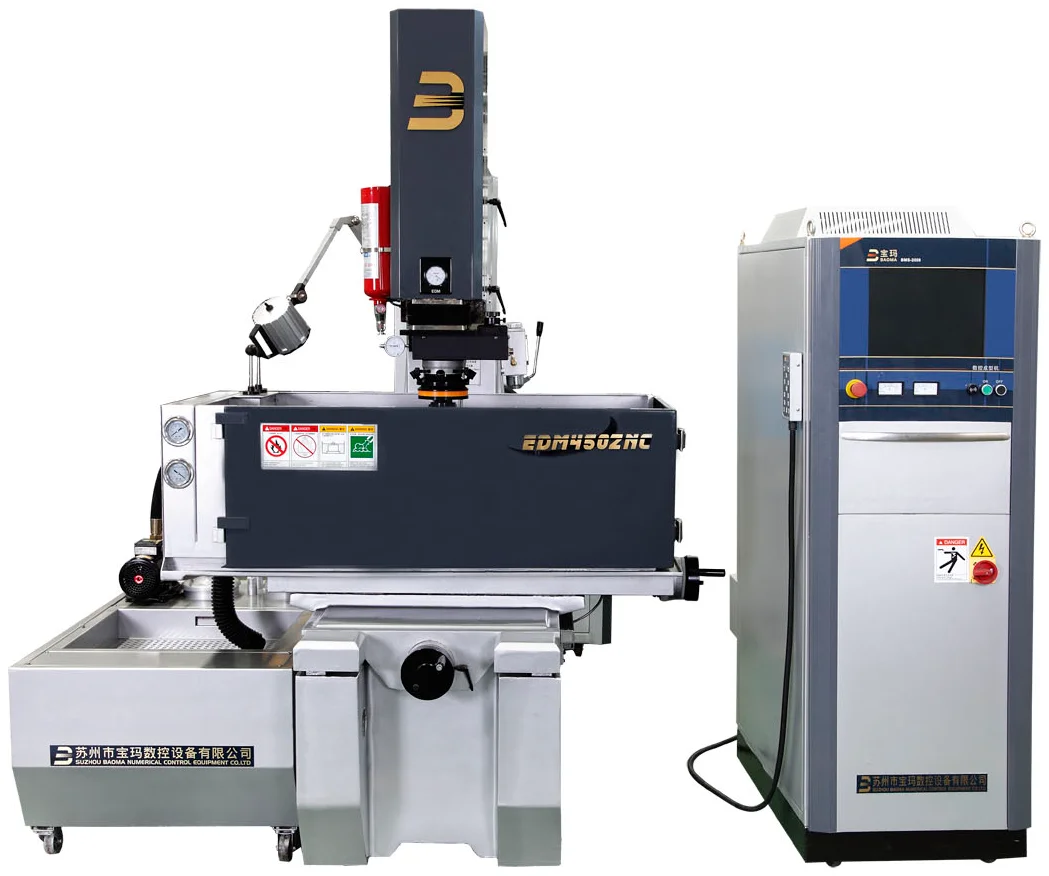
The table lists X/Y travel 450 × 350 mm, a 700 × 400 mm worktable, 1000 kg table load and 150 kg spindle load. The electrode-head-to-table distance is 180–580 mm. Its servo-stroke notation is 200 + 200 mm; obtain the drawing explaining each motion before calculating usable electrode approach.
For a mould cavity, allow for electrode holder height, cavity depth, flushing access and withdrawal. Describe whether the X/Y positions need manual setting, programmed positioning or controlled orbiting. ZNC is not proof of simultaneous three-axis cavity machining or an automatic electrode magazine. List the actual positioning, orbiting and change functions in the selected build.
The published ≤0.2 Ra μm best-surface entry explicitly requires an orbiting head. It cannot be applied to a basic configuration automatically. The 400 mm³/min maximum rate and ≤0.3% minimum electrode-wear entries also need material/electrode/process conditions; they are not promises for the same finished cavity. Trial roughing and finishing electrodes separately, including corner wear and the released cavity dimensions.
Accept the hardest feature, not only a demonstration coupon
Define the result on the drawing
For wire EDM: profile location, top/bottom taper, straightness and the retained slug. For hole EDM: diameter along the depth, breakthrough or blind end and electrode wear. For sinking EDM: cavity form, corner radius, depth and surface. Specify the inspection method and any required recast-layer or surface-integrity assessment.
Freeze the consumables and process
Record material and heat treatment, electrode/wire grade, dielectric, flushing, filters and generator settings. Include rough/finish passes and electrode changes. Repeat on the intended fixture and representative material; a best finish and a peak rate should not be multiplied into a fictitious production promise.
Measure saleable output and site needs
Include loading, setting, threading or electrode replacement, filtering, inspection and rejects. Obtain the selected-build foundation, power, dielectric handling, ventilation and access drawings. Confirm local safety obligations, consumable supply, training, software/parameter backups and service coverage for the installation country.
Company identity and what the standards record actually establishes
Baoma's current material identifies Suzhou Baoma Numerical Control Equipment Co., Ltd., 苏州市宝玛数控设备有限公司, in Suzhou. The range includes reciprocating-wire EDM, hole EDM and die-sinking EDM, with additional sizes and taper-oriented wire machines beyond the three distinct references above.
The national standards platform entry for JB/T 10082-2025, technical specifications for reciprocating-wire EDM machines, names this exact company among the drafting organizations. It records publication on 17 December 2025 and implementation on 1 July 2026. Drafting participation is company context; it does not certify a BMA400C or establish conformity of the delivered machine. Agree the applicable inspection documents and results on the selected build.
Confirm the legal seller and manufacturer on the quotation, destination-specific service obligations, spares and commissioning scope. Website service pledges do not establish response times at your overseas site.
Already researching a BVMC machining centre?
The directory retains BVMC850, BVMC1060 and BVMC1370 at their original addresses. The current EDM tables above do not substantiate those milling configurations. If your enquiry is for a BVMC machine, include its dated model sheet or nameplate and the intended milling operations. Confirm the exact builder, availability, spindle/tool package and acceptance drawing separately; do not apply EDM parameters to it.
Send the feature, the material and the electrode route
Attach the drawing with the hardest contour, hole or cavity highlighted. Add material/heat treatment, blank dimensions and mass, quantity and output target, fixture/electrode concept, tolerances and inspection method, dielectric/site requirements and installation destination. Name BMA400C, BMD703A-400CNC or EDM450ZNC only after selecting the process; for a BVMC enquiry include its dated sheet.
Baoma RFQ ↗