

杭州杭机数控机床有限公司
Hangzhou, Zhejiang
Hangji: fit the fixture and the full tool approach.
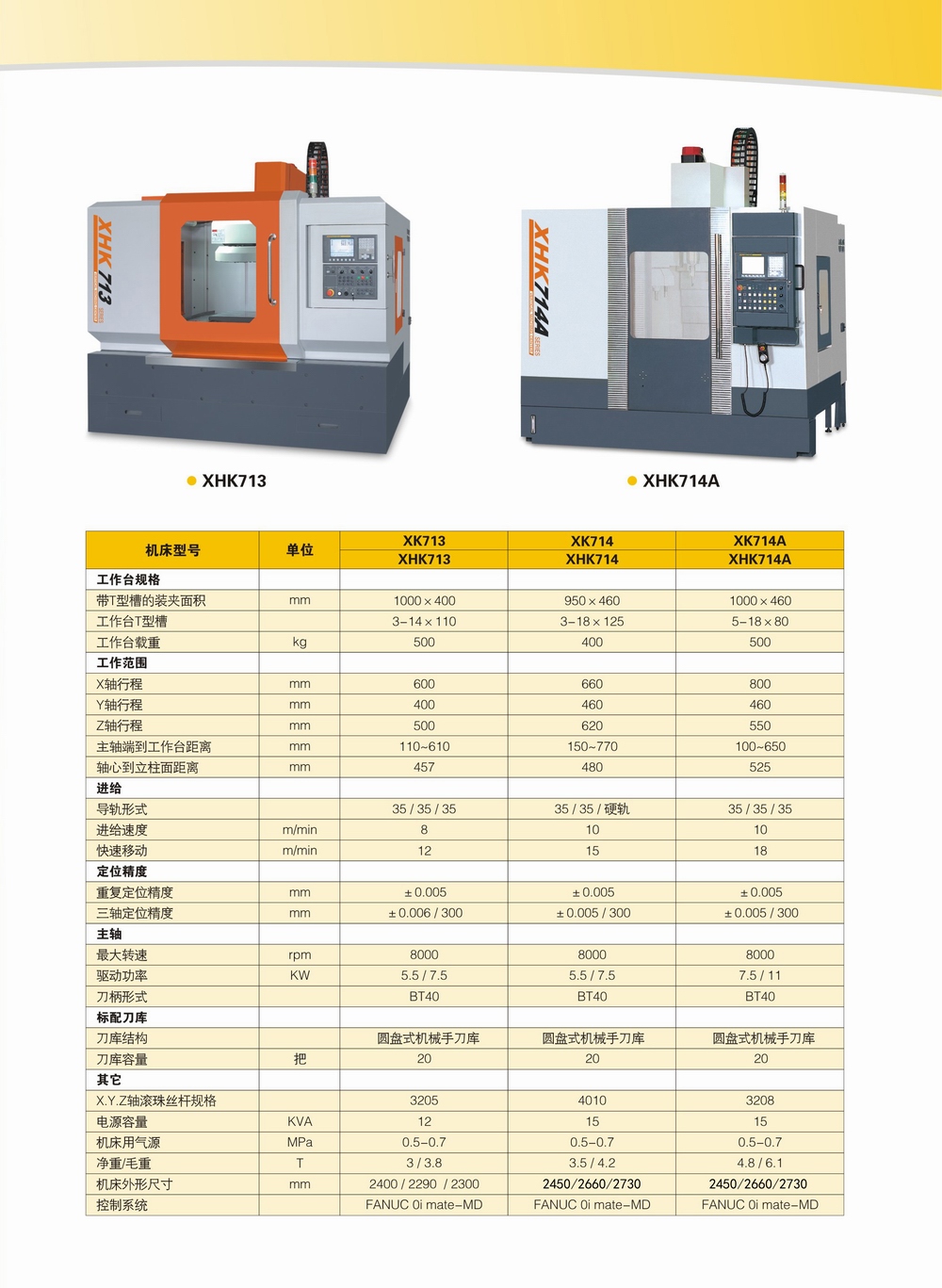
Compare four vertical machining references by loaded fixture, nose-to-table window and BT40 or BT50 tooling. Table area alone does not establish load capacity or cutter access.
Company, bilingual model tables and original catalogue reviewed 8 October 2026
A wider fixture and a heavier fixture are different requirements
Compact plate or repeatable fixture
Start with the locating face and the clamp map. XK713 lists a 1000 × 400 mm table and 500 kg load; XK714 lists a wider 950 × 460 mm table but only 400 kg. Include fixture, blank, clamps and any rotary attachment in the load calculation, then check access to every face and tool-change position.
Larger plate or heavy roughing blank
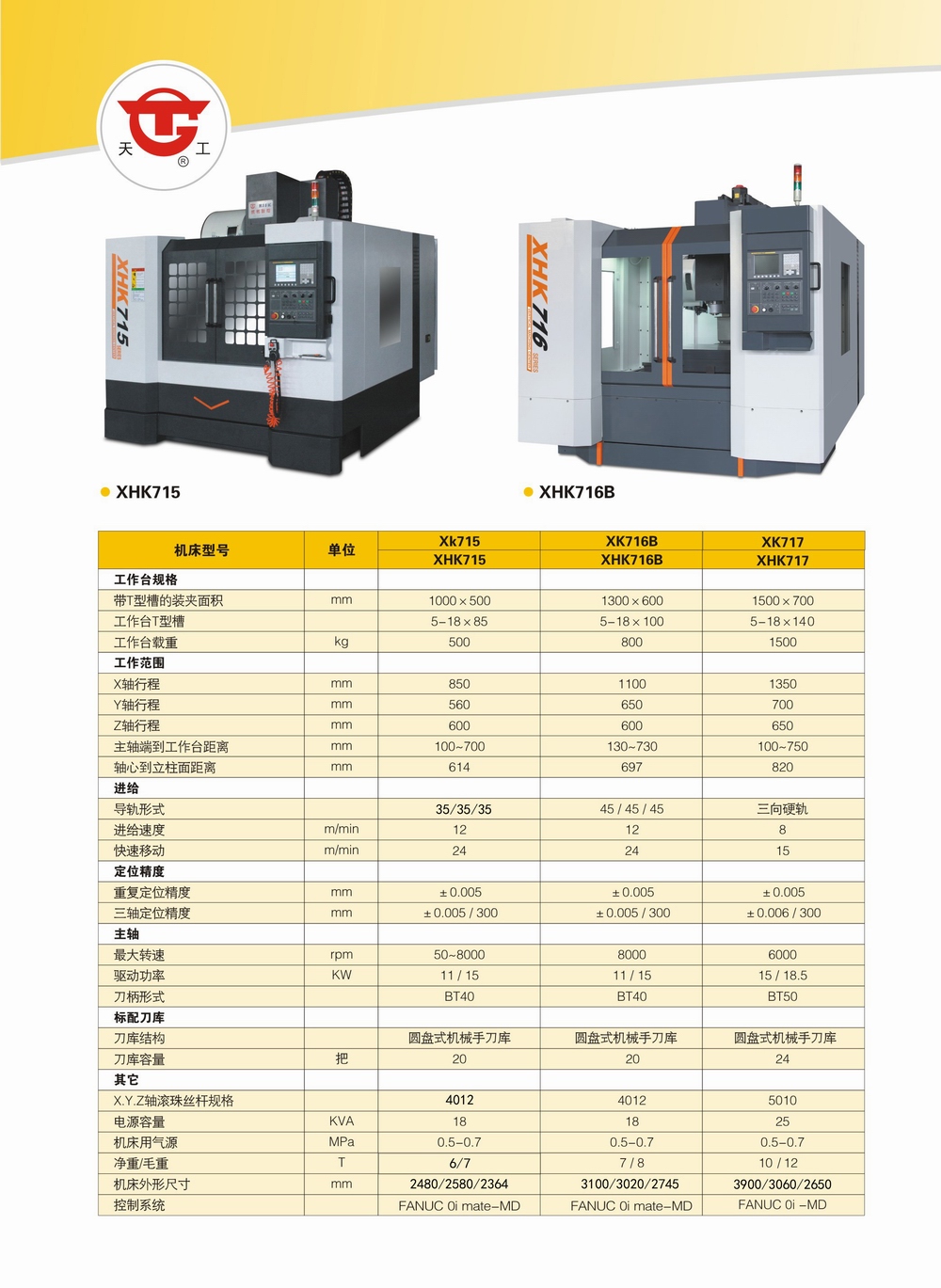
XK716B extends travel to 1100 / 650 / 600 mm with 800 kg table load and BT40 tooling. XHK1890 lists 1800 / 900 mm X/Y travel, a 2000 × 900 mm table and 1600 kg load with BT50 tooling. Check the blank's overhang and support, cutter engagement and handling route; the largest table is useful only when the complete operation fits.
Read one complete configuration column
The smaller catalogue columns pair XK and XHK designations. The current machine description, serial/build specification and automatic tool-changing arrangement should identify which version is being quoted. Do not substitute XK714A for XK714 or remove the B from XK716B.
Scroll across to compare all four versions. Keyboard users can focus the table and use the arrow keys.
| Reference | XK713 / XHK713 ↗ | XK714 / XHK714 ↗ | XK716B / XHK716B ↗ | XHK1890 ↗ |
|---|---|---|---|---|
| X / Y / Z | 600 / 400 / 500 mm | 660 / 460 / 620 mm | 1100 / 650 / 600 mm | 1800 / 900 / 680 mm; 800 mm appears as an alternative |
| Table / load | 1000 × 400 mm / 500 kg | 950 × 460 mm / 400 kg | 1300 × 600 mm / 800 kg | 2000 × 900 mm / 1600 kg |
| Nose to table | 110–610 mm | 150–770 mm | 130–730 mm | 160–840 mm; reconcile with any alternative Z build |
| Spindle / magazine | 8000 rpm / BT40 / 20 | 8000 rpm / BT40 / 20 | 8000 rpm / BT40 / 20 | 6000 rpm / BT50 / 24 |
| Net / gross mass | 3 / 3.8 t | 3.5 / 4.2 t | 7 / 8 t | 15 / 17 t |
The published series page cautions that the product manual governs the delivered machine. Its controller descriptions are legacy references, not a promise that a current quotation includes that exact control, options or postprocessor.
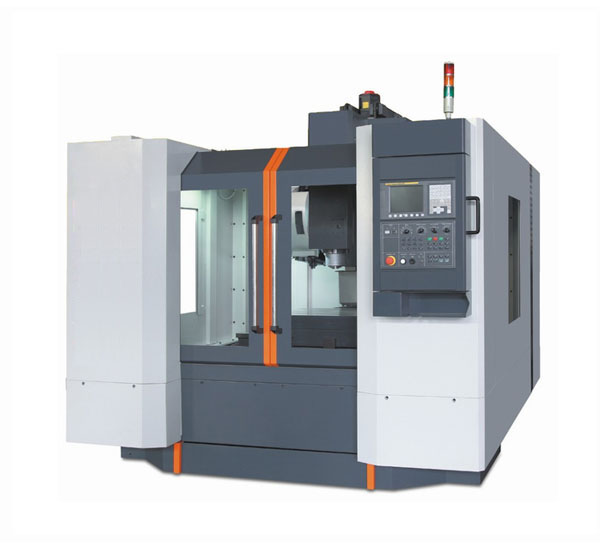
Read the complete XK716B / XHK716B catalogue sheet
Use the nose-to-table window for the actual operation
At the tallest setup
Add fixture height, blank height and tool/holder projection. Check both the deepest feature and the safe approach, retract and tool-change path. XK714 has more listed Z travel than XK713, but its minimum nose-to-table distance is also larger; the travel number alone does not establish reach to a shallow workpiece.
With an alternative Z build
XHK1890 prints Z as 680 (800) mm while its listed nose-to-table range is 160–840 mm. Confirm which version the offer covers and obtain a coordinated drawing for spindle nose, column, guards, fixture and tool. Do not add an optional travel amount to the reference range by arithmetic.
Choose the cutter's duty, then check the whole magazine
The BT40 references list drive-power pairs of 5.5 / 7.5 kW for XK713 and XK714, or 11 / 15 kW for XK716B. XHK1890 lists 15 / 18 kW with BT50. The series tables do not explain those pairs' duty rating; ask for the installed motor and spindle's continuous/intermittent power and speed/torque curve. Motor power, spindle speed and tool interface do not by themselves prove a material-removal rate.
Tool access and capacity
The published columns list a disc magazine with 20 positions on the smaller machines and 24 on XHK1890. Request the complete tool map: holder interface, occupied adjacent stations, tool diameter/length/mass, cutter projection and clearance around the fixture. Do not borrow the old XK715 sheet's tool-size limits for another model.
Guides and cutting response
XK714's reference is 35 / 35 / hard-guide in X/Y/Z; XK716B lists 45 / 45 / 45 and XHK1890 three hard-guide axes. Compare the actual lubrication, adjustment and cutting behaviour for the intended duty. The guide label is not independent proof of part accuracy or a guaranteed finish.
Inspect the released part, not only an axis report
Fix the representative setup
Use production material and condition, locating faces, fixture and tool projection. Select the feature most exposed to overhang, deep reach or clamp distortion and agree the datum and measurement method.
Run the agreed process
Retain tool, program/postprocessor and controller revisions. Include roughing and finishing, warm-up, tool changes, chip removal and inspection. Test the cutter at the actual spindle duty rather than selecting catalogue maximum rpm as an operating point.
Measure and count accepted output
Inspect critical dimensions and surface after release, repeat under the agreed conditions and record rejected pieces and tool condition. The catalogue's positioning/repeatability figures are machine-axis references; they are not guaranteed finished-part tolerances.
Identify the supplier and plan the handover
The company identifies itself as 杭州杭机数控机床有限公司 in Hangzhou, with machining centres, wire cutting and hydraulic products in its catalogue. A Zhejiang 2024 technology-based SME filing list names this exact entity at entry 5489. That dated filing is not a machine certificate, an independent inspection or proof of destination support.
Obtain the current product manual and signed configuration, electrical and air schedule, foundation/handling plan and levelling procedure. The reference air range is 0.5–0.7 MPa; power-capacity and control values should be reconciled with the installed auxiliaries. Net machine mass and shipping gross mass serve different planning decisions. Specify loading access, commissioning, inspection, training, spare components and program/parameter backups.
Request evidence for the actual ordered version and service destination. Catalogue company-age statements differ from the current company account; this page does not treat old promotional certifications or history as proof of present machine performance.
Send the fixture envelope and critical feature
Attach material and blank, drawing/datums, fixture/rotary mass and height, deepest reach, cutter/holder projection, occupied tool schedule, required output and inspection method. Name the XK/XHK version, Z build, control/postprocessor and destination foundation and utilities.
Send Hangji RFQ ↗