

上海汉霸数控机电有限公司
Shanghai · die-sinking EDM
Hanspark: plan the cavity, electrode and complete EDM setup
A compact G45L and a twin-head HF1260 serve different mold layouts. Compare usable space, electrode preparation and the surface recipe before comparing cycle time.
Official company material reviewed 8 October 2026; G45L and HF1260 model tables re-checked 29 October 2026
Start with the mold in its fixture
Show the cavity locations on the complete mold drawing, including the fixture, electrode holder and loading path. Table size, axis travel, tank size and vertical clearance are different limits. A mold that fits the table can still obstruct the electrode, prevent immersion or leave a cavity outside the reachable area.
| Setup constraint | G45L | HF1260 |
|---|---|---|
| Table | 600 × 400 mm | 1250 × 800 mm |
| Published X/Y/Z entry | 450 × 300 × 300 mm | 700/700 × 600 × 400 mm |
| Electrode plate to table | 300–600 mm | 500–900 mm |
| Maximum workpiece / electrode load | 800 / 50 kg | 6000 / 80 kg |
| Tank internal dimensions | 900 × 620 × 400 mm | 2000 × 1100 × 600 mm |
| Maximum liquid level / reservoir capacity | 240 mm / 450 L | 450 mm / 1500 L |
| Catalog machine envelope / mass | 1900 × 2150 × 2500 mm / 2500 kg | 3700 × 3250 × 2940 mm / 7000 kg |
Swipe to compare both models on a narrow phone.
HF1260's slash-separated X entry belongs to its twin-head layout. Obtain a dimensioned drawing of each head's motion, minimum spacing and accessible zones; do not interpret it as a single 1400 mm X travel. Weight limits also need written clarification about the fixture and electrode-holder mass included in each allowance.
G45L: prepare a compact precision-cavity setup
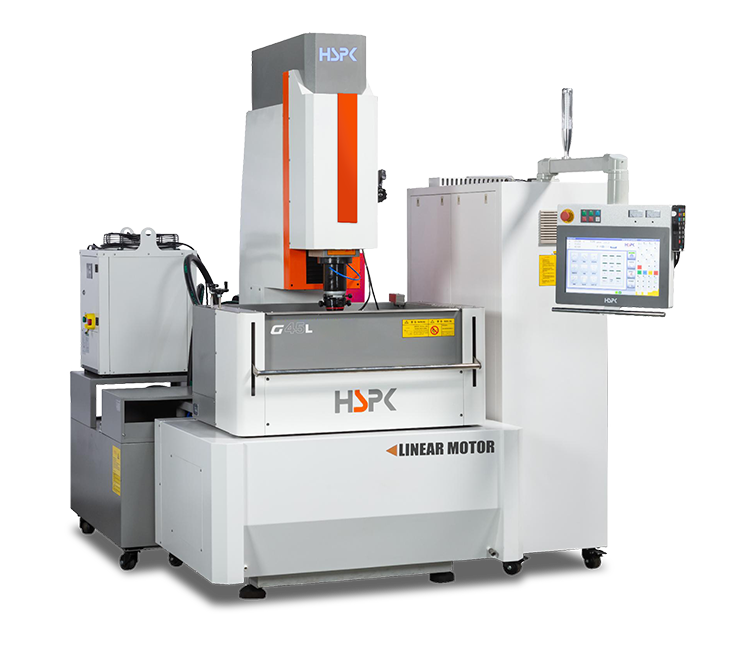
G45L's model-specific table identifies a linear-motor ram. The product description also lists working-fluid and ram cooling, and describes bed temperature control. These systems address thermal management; the finished cavity still depends on temperature conditions, electrode preparation and the chosen discharge sequence.
Check the full vertical stack: mold and fixture height, holder projection, electrode length and the required withdrawal space. The 300–600 mm electrode-plate-to-table range is not a permitted cavity depth. Include access for flushing and any probing or reference-ball routine.
The catalog lists manual tank movement and liquid-level control. If the process requires unattended changes in immersion or an automated electrode sequence, ask for the exact hardware and demonstrated sequence. A software screen mentioning ATC does not establish that a physical electrode changer is included.
HF1260: make two heads work around one mold
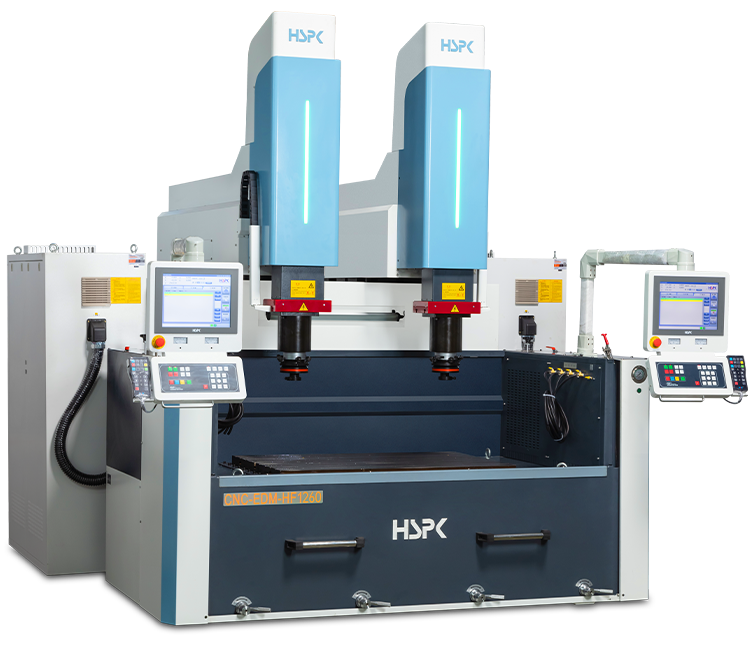
Place the cavities
Mark cavity pitch, electrode sizes and approach directions. Request each head's reachable area, clearances between holders and allowed travel when the neighboring head is operating. Resolve central or overlapping work zones on the setup drawing.
Assign the power and process
The page lists 50 A with a 100 A option, but does not clearly allocate generator ratings to each head. Specify generator quantity, independent/shared functions and the proposed concurrent roughing or finishing schedule. Two heads are not a demonstrated doubling of production.
Load and service the mold
For a heavy mold, plan lifting access, table loading and fixture positioning. The 6000 kg catalog workpiece rating is distinct from the 7000 kg machine mass. Confirm floor design, final layout, tank access and service space with the delivered package.
Explore the HF1260 model page ↗
The current official table lists AC-servo drive, three-axis simultaneous control with a five-axis expansion possibility, and manual tank/level functions. Name any extra rotary axes and their hardware, control licenses and workholding in the quotation. An expandable controller is not a standard five-axis machine.
A surface result needs its complete recipe
Hanspark repeats the same sample gallery on the two reviewed product pages. The examples below are manufacturer-published process illustrations, not independent CNCVerified tests or results proven separately on each model. They show why material, electrode count, geometry and time must accompany a finish claim.
S136 mirror example
Copper electrode Ø60, two electrodes, 2.5 mm machining depth: the manufacturer reports Ra0.1 and 6.5 hours. The source does not provide a complete pulse sequence, inspection setup or an exact machine configuration for this example.
S136 large-area texture example
Copper electrode 195 × 145 mm, one electrode, 0.5 mm depth: the reported result is Ra0.6 in 8 hours 30 minutes. A shallow large-area burn has different flushing and finish requirements from a deep narrow cavity.
The general power-unit table lists a best finish of Ra0.2, maximum removal of 500 mm³/min and minimum electrode wear of ≤0.1%. These separate catalog extrema are not a simultaneous operating point. The gallery's Ra0.1 example also needs its specific recipe explained rather than being treated as a universal machine rating.
For your part, agree on electrode material/grade, geometry, spark allowance, roughing and finishing electrode counts, flushing, dielectric conditions and measurement method. Assess corner retention, texture uniformity and dimensional results across the complete cavity, including areas that are difficult to flush.
Connect preparation to the discharge program
Establish a shared datum
The published positioning workflow links reference balls, workpieces and electrodes. Demonstrate how offsets are measured and transferred, especially after reloading an electrode or moving a mold between heads. Retain the datum and compensation record.
Choose and review the recipe
AUTO processing selects conditions from the manufacturer's database. Ask how material, electrode type, roughness and geometry are entered, how the proposed sequence is reviewed and how an operator changes an unsuitable recipe. Include a recovery demonstration after an interrupted burn.
Define the delivered interfaces
The pages list USB/LAN and FTP/HTTP/Web data services. Confirm the actual data fields, access controls, licensed functions and any required integration. Both reviewed pages name Windows 7; obtain a current control/software version and maintenance plan instead of assuming the catalog describes the delivered operating system.
Accept a process package, not only a powered-on machine
Before shipment
Run the agreed mold/electrode material and geometry. Retain programs, offsets, recipe settings and inspection results. Record setup time, electrode changes, discharge time and rework separately. For HF1260, demonstrate the proposed two-head schedule and collision-safe recovery.
At your site
Check the final electrical and utility schedule, leveling, fluid system, ventilation and access. The catalog states AC380 V, 50–60 Hz and 13 kVA with a 22 kVA option; obtain the configured whole-system load. Confirm dielectric/fire-protection procedures and operator training with the manufacturer's installation instructions.
Specify consumables, filters, electrode-holder interfaces, preventive maintenance, backup/restore procedures and remote support responsibilities. Ask for acceptance criteria for your cavities rather than transferring a gallery machining time or a command increment into a contractual part tolerance.
Choose the EDM process before comparing machines
A shaped cavity, a through contour and a starting hole need different equipment. If the drawing mixes these operations, use the wire, hole and cavity EDM selection guide to separate them before preparing the machine brief. More travel on a die-sinker does not turn it into a wire-cutting or small-hole machine.
For another die-sinking configuration to investigate, see the Makino EDGE3i model reference and Baoma EDM450ZNC model reference. Compare the complete electrode and workpiece setup, generator and control functions, electrode handling and the agreed cavity trial. These links identify the same machining process; they do not claim equivalent accuracy, automation, output or interchangeable configurations.
Hanspark's EDM development and manufacturing scope
Shanghai Hanspark CNC Electromechanical, identified in its current official material as 上海汉霸数控机电有限公司 and branded HSPK, focuses on CNC die-sinking EDM. Its company material describes development, manufacturing and assembly facilities across Shanghai, Guangdong and Jiaxing. The reviewed G and HF products show compact linear-motor and larger servo/twin-head arrangements within that catalog.
The national standards platform's plan record 20256622-T-604, issued 2 December 2025, names the exact company among drafting organizations for die-sinking EDM parameters, Part 2: double-column slide-head machines. Drafting participation is a documented technical role; it does not certify G45L or HF1260 performance or substitute for the machine's acceptance results.
CNCVerified's selection guidance above translates the published model material into a mold-production brief. It keeps optional equipment, manufacturer sample results and buyer-specific acceptance requirements separate.
Prepare a Hanspark cavity brief
Attach mold/fixture drawings, cavity locations, material, electrode plan, depth, texture and tolerance requirements. Add the desired one- or two-head workflow, batch mix, automation scope, destination utilities and proposed inspection method.
Request a Hanspark quote ↗